AsianScientist (July 19, 2017) – Indian scientists have invented a gel that can soak up spilt crude oil in the ocean. They report their findings in the journal Angewandte Chemie.
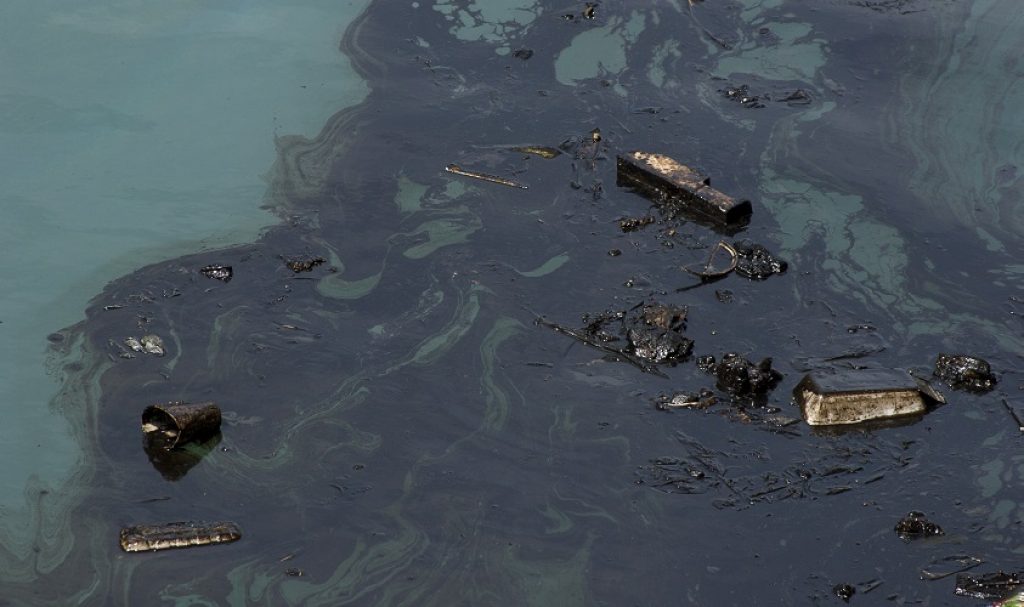
Marine oil spills are disasters that cannot be completely avoided as long as we drill for oil or transport it across the ocean. Spilt crude oil has repeatedly polluted and even destroyed marine ecosystems, incurring significant economic and environmental costs.
When oil slicks occur, it is important to recover the floating spilt oil from the water surface before it reaches the shores or is emulsified by a turbulent sea. However, current methods such as skimming or booming are often ineffective because the oil film quickly spreads out over large areas.
In this study, Associate Professor Kana M. Suresan and PhD student Mr. Annamalai Prathap from the Indian Institute of Science, Education and Research (IISER) Thiruvananthapuram in Kerala, India, have developed and tested a gel that soaks up oil like a sponge. Notably, the oil could be recovered from the gel.
The scientists chose cellulose as an environmentally friendly, cheap and porous carrier matrix. They impregnated the cellulose with a gelator—a cheap mannitol-based organic compound. This simple impregnation step proved to be key in converting the cellulose into an effective oil-absorbing and recycling system.
When the gelator molecules get dissolved in the oily phase, they form a three-dimensional fiber network through hydrogen bonding. The oil becomes trapped in this network to create a rigid gel. Thus, gelation turns the liquid oil phase into a solid one, which can be simply scooped out.
“Our invention absorbed all the oil, and the rigid globules containing the congealed oil could be scooped out after two hours, leaving the clean water,” the authors said.
The article can be found at: Prathap & Sureshan (2017) Organogelator–Cellulose Composite for Practical and Eco-Friendly Marine Oil-Spill Recovery.
———
Source: Wiley; Photo: Shutterstock.
Disclaimer: This article does not necessarily reflect the views of AsianScientist or its staff.