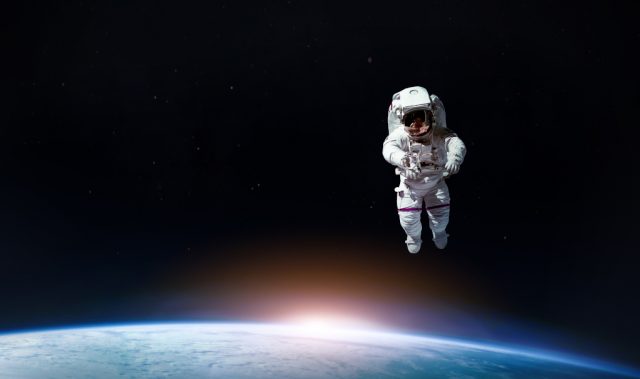
AsianScientist (Apr. 28, 2017) – In the microgravity experiments conducted at the International Space Station (ISS), scientists have uncovered a seemingly contradictory behavior of antifreeze proteins that could explain why fish don’t freeze to death in icy water. Their findings have been published in Scientific Reports.
Fish can survive even in subzero environments, such as under ice floes. Researchers have hypothesized that when glycoproteins contained in fish blood are absorbed on the surface of ice crystals, it curbs the growth of ice crystals. Verifying the functions of these glycoproteins requires precise measurements of the normal growth rates of crystals over time. Yet this is difficult to do so on the Earth because of the natural convective flow around the growing crystal induced by gravity.
The researchers, led by Hokkaido University Professor Emeritus Yoshinori Furukawa, hoped to use the microgravity conditions of space to accurately measure the normal growth rates of crystal faces, as convective flow does not occur in this environment.
To carry out the experiments on the ISS, Hokkaido University’s Institute of Low Temperature Science and JAXA jointly developed Ice Crystal Cell 2, a device for measuring the speed of ice crystal growth in space. Once installed in the Japanese experiment module KIBO, experiments were carried out by controlling the device using signals from the ground.
The researchers conducted 124 experiments of which 22 were deemed to have accurately measured ice crystal growth rates in supercooled water containing a glycoprotein impurity. The results showed that the bottom basal faces of the ice crystals grew three to five times faster than in pure water. Ice crystals also exhibited periodic oscillations as they grew.
“The results were contrary to what was expected, as the glycoprotein actually facilitated the growth of ice crystals, rather than curbing it,” said Assistant Professor Ken Nagashima of Hokkaido University.
What, then, explains glycoprotein’s antifreeze effect? The researchers discovered the tricky process in which flat crystal faces with high growth rates were truncated by faces with slower growth rates, causing the polyhedral crystal to be surrounded by only flat faces with the lowest growth rates. This greatly slowed down the growth of the ice crystals.
“Our results suggest that the prevention of freezing in living organisms cannot be solely explained by the growth depression effect of glycoproteins. In other words, the novel mechanism we observed is essential for preventing living organisms from freezing,” said Nagashima.
“The function of glycoproteins in ice crystal growth is closely connected to how biopolymers regulate the growth of various inorganic crystals. A better understanding of this may lead to the creation of novel materials,” he added.
The article can be found at: Furukawa et al. (2017) Oscillations and Accelerations of Ice Crystal Growth Rates in Microgravity in Presence of Antifreeze Glycoprotein Impurity in Supercooled Water.
———
Source: Hokkaido University.
Disclaimer: This article does not necessarily reflect the views of AsianScientist or its staff.