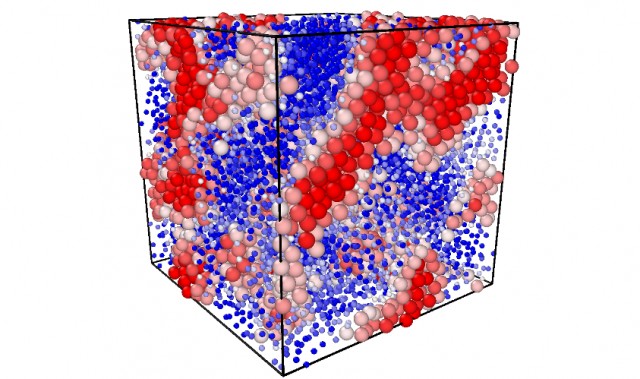
AsianScientist (Feb. 3, 2017) – A University of Tokyo research group has developed a computer program that converts the distribution of physical quantities within space into data that can be printed three dimensionally. To demonstrate their program, the group fed data derived from the software into a 3D inkjet printer and successfully produced a transparent resin model depicting the electron density distribution of carbon atoms in a fullerene molecule resembling a soccer ball.
Understanding the relationships between molecular functions and the density distributions of how electrons are spread in an atom is challenging as models which representing the three-dimensional arrangement of atoms in a molecule have traditionally resorted to the ball-and-stick format to depict atoms (as balls) and interatomic bonds (as sticks).
Instad he group led by Technical Specialist Jun Yamazaki of the University of Tokyo’s Institute for Solid State Physics succeeded in developing a program to convert the electron density distribution of a fullerene molecule (C60) into point cloud data. They fed then these dot-like data points into a 3D inkjet printer and produced a molecular model with a visual representation of an electron cloud in transparent resin.
This type of molecular model makes it easier to grasp the electron cloud of a molecule, and should help in the development of new molecular functions involving electrons. Besides visualizing electron density, the new software can create visual representations of clouds, galaxies, architectural structures, airflow around automobiles, and other phenomena, and offers the possibility of a broad range of applications in a variety of fields.
“With the ball-and-stick-type molecular model, we faced the problem of not being able to express electron densities calculated on a supercomputer; but we resolved this with our current technology,” said Yamazaki. “It is fun thinking of ways to visually portray invisible physical quantities in transparent resin.”
“I was very impressed when we produced a beautifully crafted electron cloud with the program we created,” said collaborator Mr. Shinji Nagashiro of scientific computing company X-Ability Co., Ltd. “I hope this software will contribute to the development of new sciences by elevating the visualization of computer simulation results with the electron density distribution from conventional two-dimensional images to three-dimensional representations using 3D printers.”
———
Source: University of Tokyo; Photo: Jun Yamazaki.
Disclaimer: This article does not necessarily reflect the views of AsianScientist or its staff.