10 Awesome Reasons To Love Supercomputers

From their sheer scale to the multitude of things they can do, there are many reasons to love supercomputers. Here are just ten of them!

3. They’re big

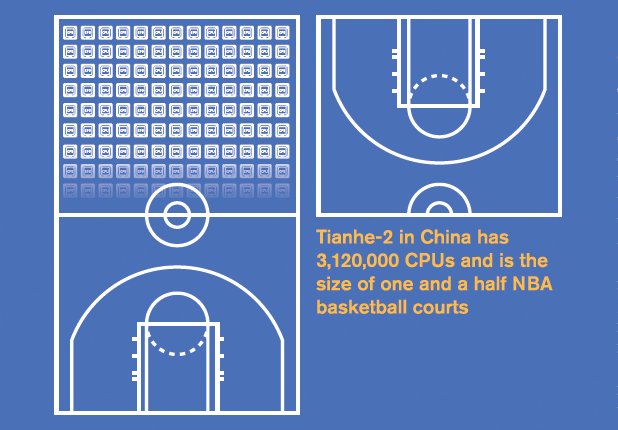
Supercomputers take up a lot of space; Tianhe-2, for example, occupies 720 square meters! Credit: Asian Scientist Magazine.

In supercomputing, size matters. Your laptop is small because it contains only two to four central processing units (CPUs) which is sufficient for you to perform basic tasks such as surfing the internet or creating word documents. Supercomputers are made up of thousands of CPUs packed closely together in rows upon rows of cabinets with very fast networks interconnecting them. This allows a supercomputer to carry out much more complicated functions in the same amount of time or less.

To return to the airport analogy, if each customs counter takes up two square meters of space, to have a thousand of them set up would require proportionately more room. This is why supercomputers like the Tianhe-2 in China occupy a whopping 720 square meters of space. That’s the size of one and a half NBA basketball courts!

<<< PREVIOUS NEXT >>>

Jeremy received his PhD from Nanyang Technological University, Singapore, where he studied the role of the tumor microenvironment in cancer progression.

Related Stories from Asian Scientist

  • Striking A Balance Between Performance And Efficiency Striking A Balance Between Performance And Efficiency Given environmental concerns, supercomputers shouldn't just be fast—they have to be efficient too. Here's how supercomputing is moving towards a greener future.
  • The Race To Exascale The Race To Exascale Professor Lu Yutong shares how China’s past experiences have shaped the country’s supercomputing efforts, and calls for more collaboration among Asian countries.
  • How To Win The Nobel Prize Of Supercomputing How To Win The Nobel Prize Of Supercomputing Winning the ACM Gordon Bell Prize in High Performance Computing requires a team effort, says Professor Fu Haohuan, a member of the 12-man team that won the competition in 2016.
  • The Next Supercomputing Superpower – Chinese Technology Comes Of Age The Next Supercomputing Superpower – Chinese Technology Comes Of Age The most powerful supercomputer in the world uses China’s home-grown technology. Could the country also be the first to build an exascale computer?
  • Getting A Headstart On HPC Getting A Headstart On HPC As high performance computing grows in relevance in various industries, Singapore Polytechnic is prepping its students for the future from the comfort of their classrooms.
  • CitySim CitySim Simulations and edge computing could help to tame some of the complexities of cities and make them more livable places for all, says Charles Catlett, director of the Urban Center for […]