AsianScientist (Nov. 3, 2016) – A team of researchers in Japan has presented a new model for the origin of Saturn’s rings based on their computer simulations. The findings were published in Icarus.
The giant planets in our solar system have very diverse rings. Observations show that Saturn’s rings are made of more than 95 percent icy particles, while the rings of Uranus and Neptune are darker and may have higher rock content. However, the origin of the rings was still unclear and the mechanisms that lead to the diverse ring systems were unknown.
The present study focused on the period called the Late Heavy Bombardment that is believed to have occurred four billion years ago in our solar system, when the giant planets underwent orbital migration. It is thought that several thousand Pluto-sized objects from the Kuiper belt, each one-fifth of Earth’s size, existed in the outer solar system beyond Neptune.
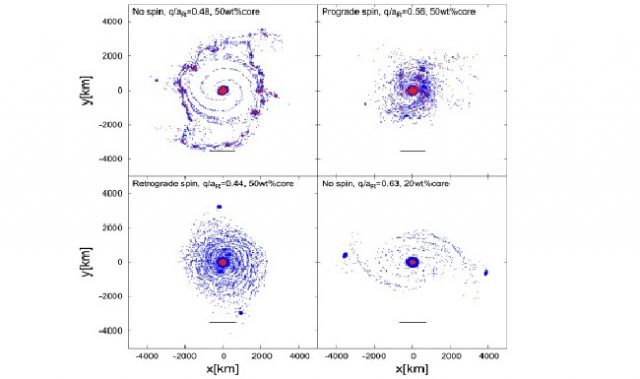
The researchers led by Dr. Hyodo Ryuki from the Kobe University Graduate School of Science first calculated the probability that these large objects passed close enough to the giant planets to be destroyed by their tidal force during the Late Heavy Bombardment. Results showed that Saturn, Uranus and Neptune experienced close encounters with these large celestial objects multiple times. Next, the group used computer simulations to investigate disruption of these Kuiper belt objects by tidal force when they passed the vicinity of the giant planets.
They discovered that in many cases, fragments comprising 0.1-10 percent of the initial mass of the passing objects were captured into orbits around the planet. In other words, these planetary rings were formed when sufficiently large objects passed very close to giants and were destroyed. The results of the simulations are also applicable to rings of other giant planets, and explain the compositional differences between the rings of Saturn and Uranus.
These findings illustrate that the rings of giant planets are natural by-products of the formation process of the planets in our solar system, implying that giant planets discovered around other stars likely have rings formed by a similar process.
The article can be found at: Hyodo et al. (2016) Ring Formation Around Giant Planets by Tidal Disruption of a Single Passing Large Kuiper Belt Object.
———
Source: Kobe University; Photo: Shutterstock.
Disclaimer: This article does not necessarily reflect the views of AsianScientist or its staff.