AsianScientist (Oct. 18, 2016) – A team of researchers in Korea has developed a simpler way to mass-produce ultra-thin graphene thermoacoustic speakers. Their research results were published online in Applied Materials and Interfaces.
Thermoacoustic speakers generate sound waves from temperature fluctuations by rapidly heating and cooling conducting materials. Unlike conventional voice-coil speakers, thermoacoustic speakers do not rely on vibrations to produce sound, and thus do not need bulky acoustic boxes to keep complicated mechanical parts for sound production. They also generate good quality sound in all directions, enabling them to be placed on any surface—including curved ones—without canceling out sounds generated from opposite sides.
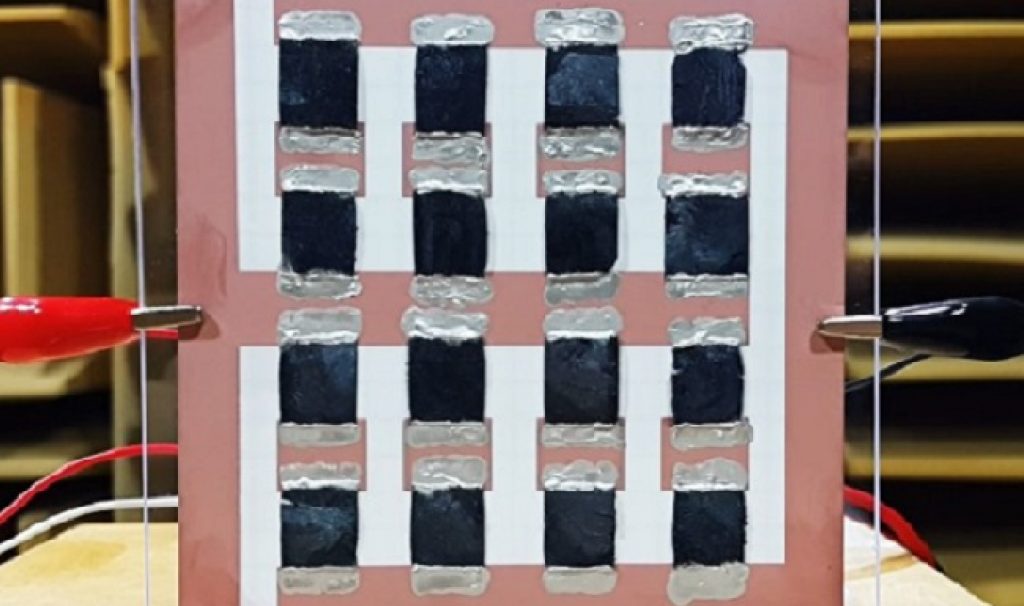
Led by Professors Choi Jung-Woo, Cho Byung Jin and Kim Sang Ouk of the Korea Advanced Institute of Science and Technology (KAIST), the research team used 3D graphene aerogels to fabricate an array of loudspeakers that were able to withstand over 40 W input power and that showed excellent sound pressure level, comparable to those of previously reported 2D and 3D graphene loudspeakers. Based on a two-step, template-free fabrication method, the research team produced a N-doped, 3D, reduced graphene oxide aerogel with a porous macroscopic structure.
“Thermoacoustic speakers have a higher efficiency when conducting materials have a smaller heat capacity. Nanomaterials such as graphene are an ideal candidate for conductors, but they require a substrate to support their extreme thinness. The substrate’s tendency to lose heat lowers the speakers’ efficiency,” said Mr. Kim Choong Sun, who is the first author and a doctoral student at KAIST.
The article can be found at: Kim et al. (2016) Application of N-Doped Three-Dimensional Reduced Graphene Oxide Aerogel to Thin Film Loudspeaker.
———
Source: Korea Advanced Institute of Science and Technology.
Disclaimer: This article does not necessarily reflect the views of AsianScientist or its staff.