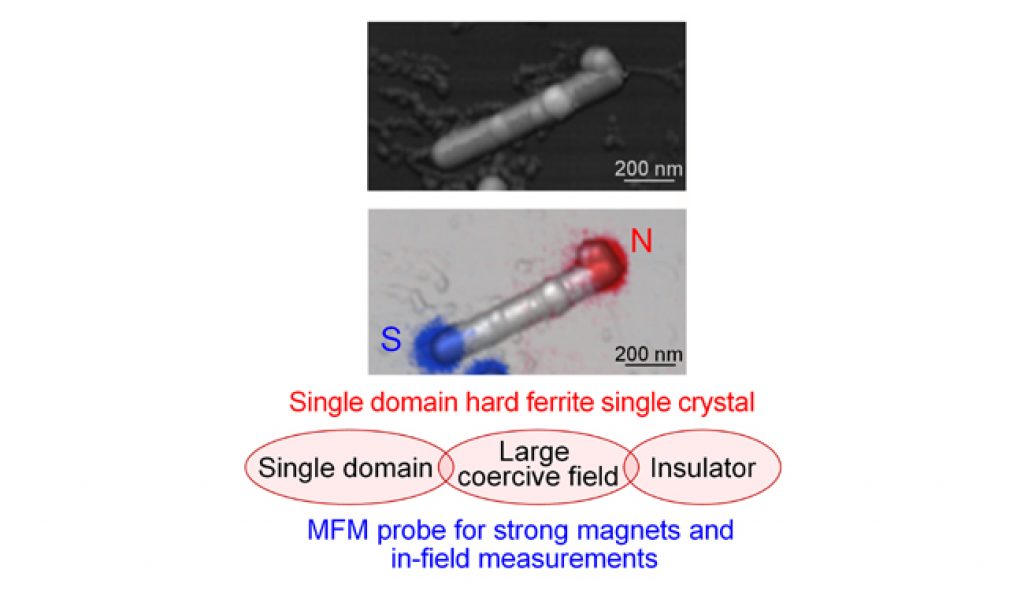
AsianScientist (Jul. 6, 2016) – A research group in Japan has developed a sub-micrometer size, extremely powerful ferrite bar magnet that can be used as a magnetic force microscopy probe.
The probe makes it possible to observe the surface of strong magnets and conduct measurements under a magnetic field, which are both difficult to do with conventional techniques. The work was published in Scientific Reports.
Ferrite bar magnets are composed of abundant and low-cost materials and have been used in toys, stationery and crafts. Typical black ferrite bar magnets are produced by hot pressing magnetic powder and therefore do not have a single magnetic domain (one pair of North and South poles).
Instead of compressing magnetic powder, a research group led by Professor Shin-ichi Ohkoshi at the University of Tokyo’s Graduate School of Science used a unique chemical synthesis method to develop single crystal hard ferrite bar magnets with a single magnetic domain.
The sub-micrometer size, single crystal ferrite bar magnet is composed of epsilon ferric oxide (ε-Fe2O3), whose magnetic poles do not easily flip even when exposed to strong magnetic fields. It is resistant to electric currents and does not rust.
Taking advantage of these properties, the research group developed a probe for magnetic force microscopy, and a paint and film using the material as a high frequency millimeter wave absorber. The researchers also predict that the bar magnet may have applications in the Internet of Things.
“We expect this ferrite bar magnet to find applications in the emerging Internet of Things as a high frequency millimeter wave absorbing material, say for safe driving support systems,” said Ohkoshi.
The ferrite magnet in this research will be displayed in a special exhibition at the London Science Museum from July 15, 2016.
The article can be found at: Ohkoshi et al. (2016) Mesoscopic Bar Magnet Based on ε-Fe2O3 Hard Ferrite.
———
Source: University of Tokyo; Photo: Shutterstock.
Disclaimer: This article does not necessarily reflect the views of AsianScientist or its staff.