AsianScientist (Jun. 23, 2016) – Researchers in a Franco-Japanese research partnership have developed a ‘brute force’ technique to test thousands of biochemical reactions at once and quickly home in on the range of conditions where they work best. They published details of their technique in Nature Chemistry.
Until now, optimizing such biomolecular systems would have required months or years of experimental trial and error. With this new technique, however, that step could be shortened to days.
“We are interested in programming complex biochemical systems so that they can process information in a way that is analogous to electronic devices,” explained Associate Professor Yannick Rondelez from the University of Tokyo’s Institute of Industrial Science (IIS), who was the corresponding author of the study.
“If you could obtain a high-resolution map of all possible combinations of reaction conditions and their corresponding outcomes, the development of such reactions for specific purposes like diagnostic tests would be quicker than it is today.”
While computer simulations can test millions of conditions, they are based on assumptions about how molecules behave and may not reflect the reality in full detail, according to Rondelez. On the other hand, experimentally testing all possible conditions—even for a relatively simple design—is a daunting job.
Rondelez and his colleagues at the Laboratory for Integrated Micro-Mechanical Systems (LIMMS), a 20-year collaboration between the IIS and the French CNRS, demonstrated a system that can test ten thousand different biochemical reaction conditions at once.
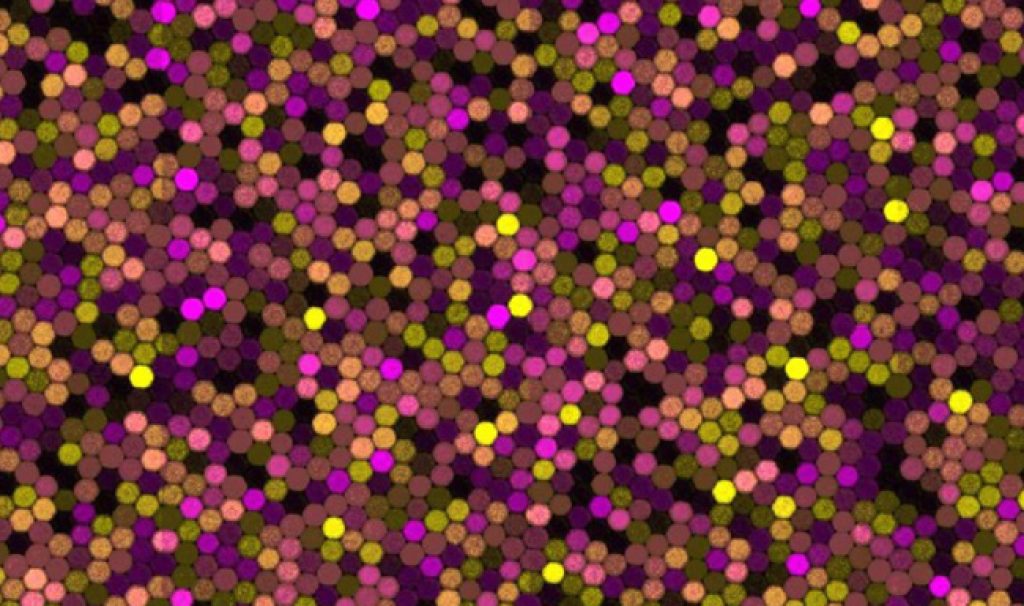
Working with Professor Teruo Fujii at the IIS Applied Microfluidic Laboratory, they developed a platform to generate a myriad of micrometer-sized droplets containing random concentrations of reagents—a single layer of droplets was then sandwiched between glass slides.
Fluorescent markers combined with the reagents are automatically read by a microscope to determine the precise concentrations in each droplet and also observe how the reaction proceeds.
“You start with a screen full of randomly-colored dots, and then suddenly the computer rearranges them into a beautiful high-resolution map, revealing hidden information about the reaction dynamics,” explained Rondelez. “The map can tell us not only about the best conditions of biochemical reactions, it can also tell us about how the molecules behave in certain conditions.”
Using this map, the researchers have already found a molecular behavior that had been predicted theoretically, but had not been shown experimentally.
The article can be found at: Rondelez et al. (2016) High-Resolution Mapping of Bifurcations in Nonlinear Biochemical Circuits.
———
Source: University of Tokyo; Photo: Yannick Rondelez.
Disclaimer: This article does not necessarily reflect the views of AsianScientist or its staff.