AsianScientist (Apr. 12, 2016) – A study by researchers from the National Centre for Biological Sciences, Bangalore has tracked how the genome of the much-studied Escherichia coli bacterium supercoils as it goes through different growth phases. The findings were published in Nature Communications.
“A bend and a twist, then stretch and turn, now relax.”
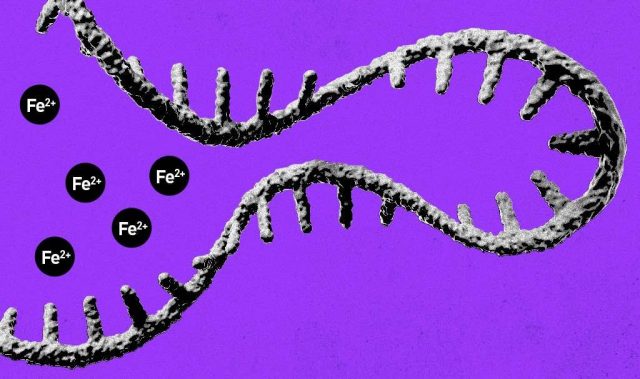
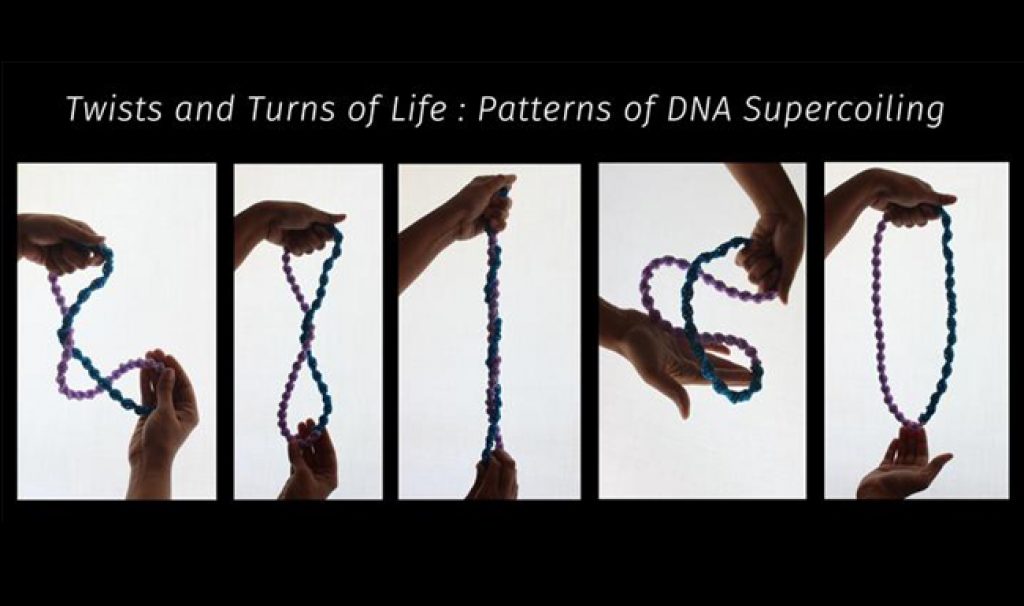
What sounds like a series of yoga instructions can also describe the various shapes a piece of DNA can assume. The classic double helix structure that one associates with DNA is but an extremely limited view of its physical ‘shape’—DNA is capable of further winding itself into myriad complex shapes called ‘supercoils’ that are capable of affecting gene expression patterns.
DNA molecules are wound and rewound into complex structures that condense their immense lengths to a fraction of their actual size in order to fit their long strings of information into microscopic cells. But this ‘packed’ DNA that fits neatly into a cell also needs to be ‘unpacked’ periodically for gene expression and replication.
When a gene is expressed, it is ‘read’ by protein machineries to create a messenger transcript that codes for more proteins. This requires DNA to be unwound from its double helix—a process that causes further twisting and coiling or ‘overwinding’ in regions of DNA elsewhere on the genome.
Similarly, unwinding and overwinding also occurs when the genome replicates during reproduction. Therefore, at any given time, a cell’s genetic material is in a constant state of structural flux—coils, supercoils, bends, twists and turns are formed, lost and reformed depending on the cell’s state of activity.
A bacterial cell can be exposed to various environmental changes which include periods of starvation, lack of oxygen and unfavorable temperatures. Surviving these situations would require the bacterium to change its protein repertoire by altering the corresponding genetic expression profiles. Scientists have long thought that these changes could be effected through variations in the supercoiled structure of DNA.
For example, the genomes of actively dividing cells under rich-nutrient conditions are known to be more underwound than the genomes of cells from the stationary phase when nutrients are scarce. In other words, supercoiling is likely to be sensitive to changes in the environment.
Although recent advancements in methodology have allowed researchers to study DNA supercoiling in human and yeast cells at local scales, this methodology has previously never been applied to bacterial genomes.
“We have measured DNA supercoiling at a fine-scale resolution in bacteria for the first time. This study provides proof-of-concept that the supercoiling of a genome is not uniform and that it varies locally across genes,” said PhD student Ms. Avantika Lal, the first author of the publication.
“It also provides evidence to support the hypothesis that bacterial cells could be regulating gene expression and their own physiologies by altering the structure of their genomes.”
In order to study the effect of environmental stimuli on the supercoiling status of the bacterial genome, the team used the chemical trimethylpsoralen, exposure to UV light and microarray technology to gain information on section-specific variations in genomic supercoiling.
Two populations of E. coli were used to simulate two different external conditions. One simulated a nutrient-rich situation where actively dividing cells represented a growing population; whereas the other represented a condition where a population had exhausted its nutrients and was in a ‘stationary’ phase.
The results have shown that the E. coli cells in the ‘stationary’ phase display a gradient of supercoiling across their circular genomes. In actively dividing cells, however, this gradient was missing, though the entire genome was more supercoiled than the genomes of cells from the ‘stationary’ phase.
“It is very early days yet, but this work paves the way to understanding which genes’ expression are affected by the environment,” said Avantika.
“This work can potentially teach us how we could control cell physiology by altering genetic expression via changes to DNA supercoiling by altering external conditions.”
The article can be found at: Lal et al. (2016) Genome Scale Patterns of Supercoiling in a Bacterial Chromosome.
———
Source: National Centre for Biological Sciences.
Disclaimer: This article does not necessarily reflect the views of AsianScientist or its staff.