AsianScientist (Mar. 7, 2016) – Researchers in Japan have identified a Pac Man-like enzyme called Trimmer that is involved in the generation of a class of small RNAs which protect the genome of germ cells from unwanted genetic rewriting. Their work was published in Cell.
‘Jumping genes,’ or transposons, are small segments of DNA that can move around the genome. They can disrupt host genes and have been linked to cancer and other diseases. As a result, organisms need to keep them under control, particularly in germ cells that give rise to sperm and eggs in animals to ensure the genomic integrity of offspring.
This is accomplished in germ cells by a class of small RNAs called PIWI-interacting RNAs, or piRNAs, that suppress jumping gene expression. They are typically 24 to 30 nucleotides long. piRNAs are thought to be matured by trimming one end of their longer precursors (pre-piRNAs) to the final mature length. However, the enzyme responsible for this trimming process was unknown.
Together with their colleagues at the University of Tokyo Institute for Molecular and Cellular Biosciences, research associate Natsuko Izumi and Professor Yukihide Tomari successfully identified a previously uncharacterized ribonuclease as the trimming protein Trimmer in silkworm ovary cells.
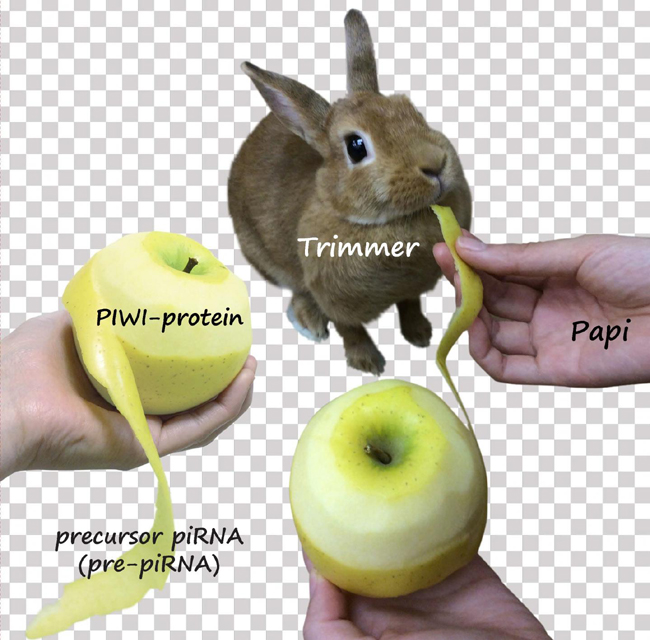
Their data showed that Trimmer cannot act alone, and requires Papi, a PIWI-associated protein, to trim the end of the pre-piRNAs. Moreover, they demonstrated that trimming of the pre-piRNAs is important for the function of piRNAs, and probably takes place on the surface of the mitochondria.
“We discovered the trimming activity in the pellet of silkworm cells back in 2011 and we knew the enzyme existed in the pellet. But, being insoluble, it was extremely difficult to identify Trimmer. In fact, we almost gave up many times,” said Tomari.
“A breakthrough came when we noticed the trimming activity is enriched in the mitochondria fraction of cells. We then patiently searched for conditions to solubilize the trimming activity from mitochondria. Even so, it still took another three years to identify Trimmer.”
“The second breakthrough came when we realized that Trimmer partners with Papi. Discovering a nuclease that interacts with Papi and has pre-piRNA trimming activity, we were thrilled to find that it was the enzyme we had been searching for all along.”
The article can be found at: Izumi et al. (2016) Identification and Functional Analysis of the Pre-piRNA 3′ Trimmer in Silkworms.
———
Source: University of Tokyo; Photo: Shutterstock.
Disclaimer: This article does not necessarily reflect the views of AsianScientist or its staff.