AsianScientist (Mar. 25, 2016) – Researchers in China have discovered which part of the brain mediates viewing optical illusions and how neurons integrate local visual cues to form a global representation of movement in the illusion. The article was published in Human Brain Mapping.
An apparently effortless task, the opening of our eyes, engages an extensive and anatomically complex network of brain areas. Visual illusions have fascinated mankind for thousands of years, and the study of the mismatch between perception and reality helps us to better understand the creative nature of the human visual system and ultimately may lead to deeper insights of how our brain works.
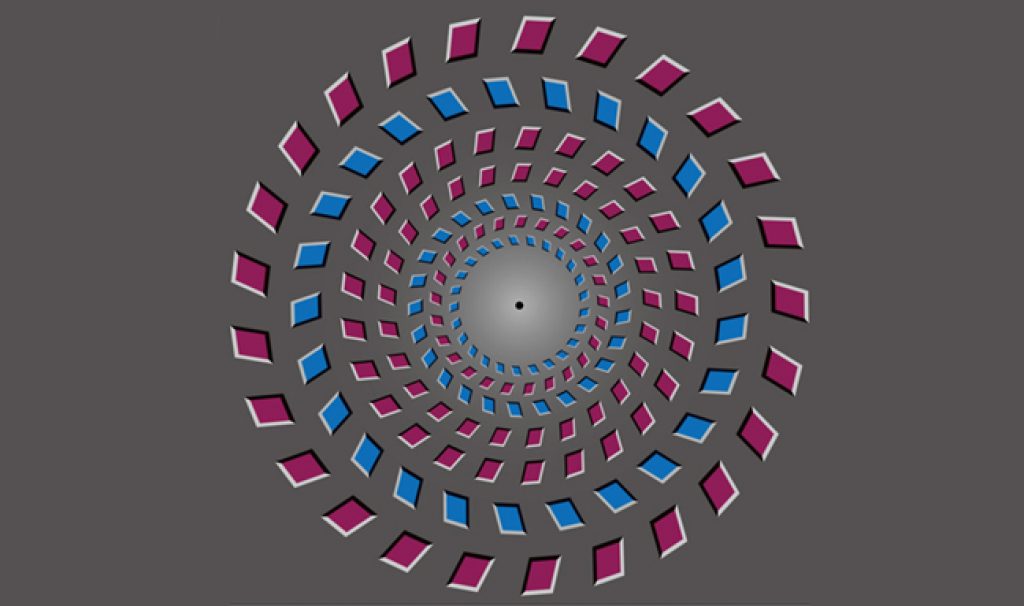
The Pinna illusion above is a striking example of rotary motion perception in the absence of physical motion. When approaching or receding concentric rings composed of static rhombi slanted in opposite directions, observers experience vivid illusory counter rotation. Although this phenomenon is well known, where and how does this happen in the human brain?
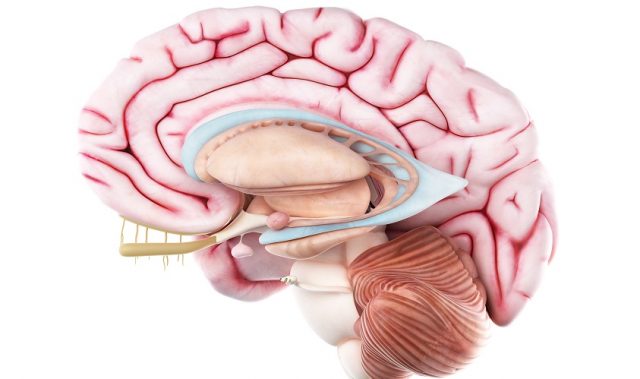
Researchers at the Institute of Neuroscience, Shanghai Institutes for Biological Sciences, Chinese Academy of Sciences employed human psychophysics and fMRI methods to examine the representation of Pinna illusion in early and intermediate visual areas. Among these visual areas, they found that in the dorsal visual stream, the subarea medial superior temporal (MST) of the human middle temporal complex was predominantly activated by the Pinna figure compared to the middle temporal subarea.
By contrast, no significant activations in earlier visual stages and the ventral stream were related to the rotation per se. Thus, their results for the first time provide direct evidence demonstrating that illusory rotation is represented as if it were real rotary motion in human MST.
These findings imply that the Pinna illusion is represented by neurons capable of encoding physical rotation in MST, and thus might help us to gain insights into how our brain perceives the visual illusion and the reality.
The article can be found at: Pan et al. (2016) Representation of Illusory and Physical Rotations in Human MST: A Cortical Site for the Pinna Illusion.
———
Source: Chinese Academy of Sciences; Photo: Luo Junxiang/CAS.
Disclaimer: This article does not necessarily reflect the views of AsianScientist or its staff.