AsianScientist (Feb. 2, 2016) – The April 2012 Sumatra earthquake induced increased seismic activity in northeastern Japan, revealing that elastic disturbances in the Earth’s crust spread over a broad area.
This discovery, made by an international research team and published in Science Advances, could help to improve our understanding of the Earth’s elastic system and of the physics of earthquake occurrence.
Earthquakes are caused by rocks slipping on both sides of a tectonic fault when the buildup of stress reaches a critical level. It is also well known that seismic “surface waves” generated by huge earthquakes can sometimes travel thousands of kilometers through the Earth’s crust and trigger earthquakes in other locations.
Research groups at the Earthquake Research Institute of the University of Tokyo, Los Alamos National Laboratory and the Massachusetts Institute of Technology revealed that when surface waves from the magnitude 8.6 Sumatra earthquake passed through the Japanese Islands, in addition to triggering earthquakes, they also resulted in widespread changes in crustal strain and seismic velocity.
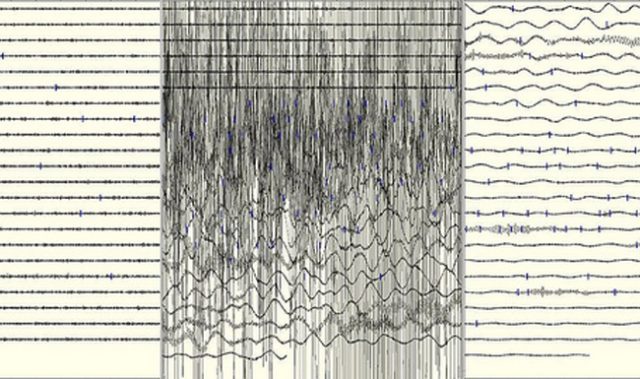
The research groups used continuous seismic data recorded by the Hi-net (High Sensitivity Seismograph Network) operated by the National Research Institute for Earth Science and Disaster Prevention, Japan, to make this discovery. The group also observed induced earthquakes off the Fukushima Prefecture that migrated southwestward at about 70 km per day, and simultaneously detected compressional strain along the coast line.
Furthermore, there was an increase in seismic velocity lasting for about three weeks beneath a wide area around the coast line of northern Japan.
“Surface waves from the Sumatra earthquake caused a change in forces within the crust that induced earthquakes due to a normal faulting mechanism within the shallow crust offshore from Fukushima, which was already close to fracture due to the 2011 Tohoku earthquake,” said Prof. Kazushige Obara, director of the Earthquake Research Institute at the University of Tokyo.
Obara added that the offshore earthquake zone stretched in an east-west direction, in turn pushing into and compressing the coastal area. The compressive stress caused cracks in the upper crust under the mainland were closed, increasing the seismic velocity in the crust.
The article can be found at: Delorey et al. (2015) Cascading Elastic Perturbation in Japan Due to the 2012 Mw 8.6 Indian Ocean Earthquake.
———
Source: University of Tokyo; Photo: Kazushige Obara.
Disclaimer: This article does not necessarily reflect the views of AsianScientist or its staff.