
AsianScientist (Feb. 25, 2016) – Laborious experiments are conducted with expensive equipment. The results are painstakingly recorded, then depicted on graphs and narrated in prose. But those findings do not become part of our collective scientific knowledge until journals publish them. In that sense, academic publishing is the handmaiden of science, helping to disseminate knowledge and spark new ideas.
The industry has evolved dramatically from its humble origins, 350 years ago, when the Royal Society of London published the world’s first scientific journal. Today it is a multi-billion dollar industry dominated by an oligopoly of for-profit publishers, “The Big Four”: Reed-Elsevier, Wiley-Blackwell, Springer and Taylor & Francis. (Elsevier is the science and medical publishing arm of Reed-Elsevier.)
In the natural and medical sciences, the Big Four and the American Chemical Society together accounted for more than half of all journal articles published in 2013.
The Big Four were all founded sometime between 1807 and 1880. Each has hundreds of years of institutional history and significant economic clout. But in 1991 they were in for a rude shock. World Scientific Publishing Company (World Scientific henceforth), a young, Singapore-headquartered firm, won the publishing rights for the Nobel Lectures, which had been held by Elsevier since 1901.
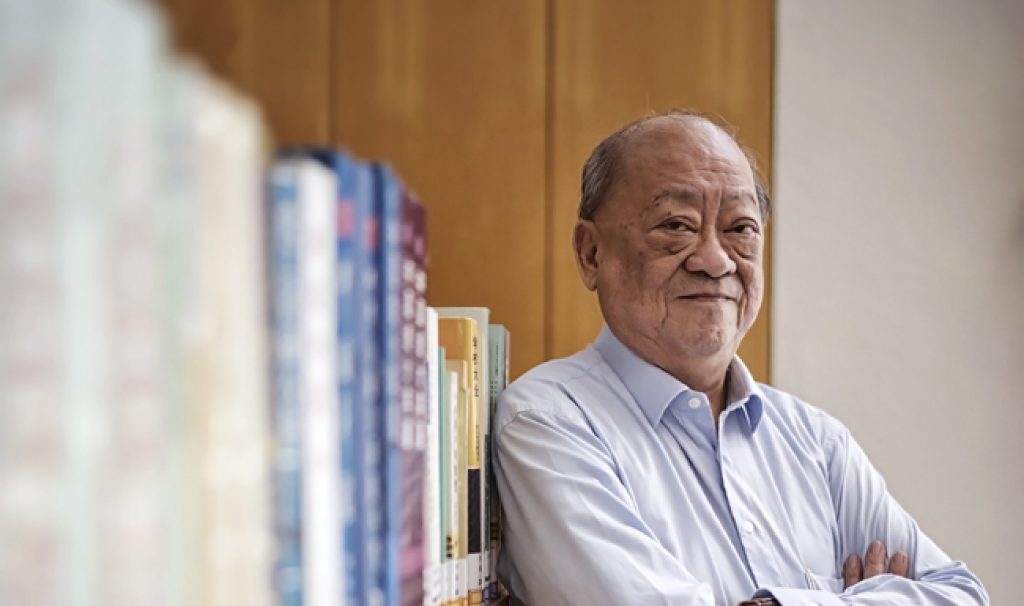
“When we started World Scientific in 1981, there weren’t any world-class international publishing houses in Asia,” recalls Phua Kok Khoo, the firm’s founder and director of the Institute of Advanced Studies at Nanyang Technological University.
“There were established publishers in Japan and China, but they focussed on Japanese or Chinese language titles. Encouraged by Nobel Prize winners that I knew personally—Abdus Salam and C. N. Yang—we decided to start something in the English-speaking environment of Singapore.”
(Full disclosure: World Scientific is a shareholder of Asian Scientist Publishing, the publisher of this non-commercial book.)
The ‘Golden Age’ of theoretical physics
Professor Phua, who obtained his PhD from the University of Birmingham in 1970, began his scientific career as a theoretical high-energy physicist, seeking to understand the mathematical behaviour of elementary particles within an atom’s nucleus.
“In the early 1970s, there were many theoretical physicists returning to Singapore from their training overseas,” he says. “Many of them were alumni of Nanyang University and returned there to teach, making its theoretical physics department very strong.”
As opposed to experimental physics research, which sometimes requires multi-billion dollar facilities such as the Large Hadron Collider, the field of theoretical physics can progress with little more than a pen and a piece of paper. More important than computers, contends Professor Phua, are “ideas, creativity and innovation”.
The discipline’s low budgetary requirements, combined with the wave of returnees, meant that theoretical physics enjoyed what Professor Phua considers a “golden age” in Singapore’s post-independence years.
“Right up to the merger with the University of Singapore in the 1980s, we [Nanyang University] were publishing papers in the best journals in the field, places like the American Physical Review and others,” says Professor Phua.
“But when the funding shifted to more applied research we had to change our focus to survive.”
For Professor Phua, that was the spur not for a simple research shift, but a foray into an entirely new industry—science, technology, engineering and mathematics (STEM) publishing.
Keeping it in the family
Thankfully he had a hereditary head start. Professor Phua’s father, Phua Chye Long, owned a Chinese publishing company, South Island Press.
Furthermore, Professor Phua was certain that the world’s scientific centre of gravity was shifting to Asia. He was eager to free researchers in Asia of their dependence on Western publishing houses.
Starting a publishing company from scratch, however, was risky. Professor Phua and Doreen Liu, his wife, had two young children at the time. In order to raise the necessary capital, they had to mortgage the family home. Thankfully, their gamble paid off.
Now in its third decade, World Scientific has a stable of 10,000 books and 130 journals and more than 500 employees across its offices in China, India, Israel, Japan, Germany, the UK, the US and, of course, Singapore. (By comparison, Elsevier, the world’s biggest journal publisher, has a stable of 33,000 books and 2,500 journals.)
“If you look at the statistics, more and more good research papers are being published by Asian researchers. We were fortunate to have entered the market at the right time,” Professor Phua quips.
Despite its international growth and interest from potential buyers, Professor Phua is adamant that World Scientific must remain a family business. Ms Liu is the firm’s group managing director while their son, Max Phua, is its managing director.
“Publishing is not like banking or opening up a restaurant—it’s a cultural activity, not totally commercial,” he stresses.
“Running World Scientific as a family business allows us to publish books that might not make a lot of money but are the best in the field. For example, we just published a book of selected writings of the leading physicist Freeman Dyson. It probably won’t be a bestseller but it is an important record of the life and work of a world-class scientist.”
According to Professor Phua, what distinguishes World Scientific from the competition is the fact that it is run by a scientist with a natural love for science. Other firms tend to be managed by “accountants, lawyers and businessmen”, who may not have had research experience. They can end up prioritising commercial imperatives to the detriment of the science.
The digital age
Just like the rest of the publishing world, academic publishing is facing severe digital disruption. The unusual structure of the industry has long made for a very profitable business. Driven by the need to “be published”, the scientists who produce the content relinquish copyright control to the journals for free; the content is then peer reviewed for free; and the demand for subscriptions is inelastic. In 2012 Elsevier enjoyed a profit margin of 38 percent on revenues of £2.1bn (about S$4.2bn).
Journals used to turn a blind eye on informal sharing of published works within the scientific fraternity. But in recent times, as the world wide web has catalysed the (free) distribution of published papers, copyright holders have sought to exercise their legal rights, ordering the removal of content from websites, including professors’ home pages.
All this has attracted a growing chorus of dissent. Arguing that publishers make huge profits out of what is typically publically-funded research, scientists such as Fields medallist Timothy Gowers have called for a boycott of major publishers that hide their research behind expensive paywalls.
New business models, including the successful open-access Public Library of Science series, have also sprung up in the last decade. Many countries, including the UK and the US, are in the midst of a legislative shift towards greater open access.
Through it all, Professor Phua remains confident that World Scientific will continue to succeed if it sticks to its guiding principles.
“I think the game is still the same. The most important thing is still content—whether people access it electronically or on hard copy,” he says.
In any case, World Scientific’s digital transition appears well underway. All of its journals are currently available digitally as “hybrid journals”—with the option for authors to pay to make their articles open access. Digital’s share of revenues is already some 65 percent; the company expects it to rise to a long-run equilibrium of about 70 percent.
A hunger for home-grown heroes
What does concern Professor Phua, however, is the relative lack of a culture of reading and creativity in Singapore.
“What students here lack is the urge to learn,” he notes. “Unlike Cambridge or Harvard, you don’t see students on the campuses here reading. Without that habit, we become machines, able to read and write but not think out of the box.”
This segues onto another of Professor Phua’s longstanding concerns: the need for Singapore to better groom home-grown scientific talent. Citing the example of Nagoya University in Japan, which has produced six Nobel laureates since 2001, he feels that it is possible for other Asian countries to create a culture of research excellence.
“If you study how Nobel laureates produced their best work, you will see that flexibility and the courage to try new ideas was instrumental,” he says.
“So there’s no point in talking about how many years it will take for Singapore to produce a Nobel laureate; we need to talk about creating the right environment first.”
As a recently appointed fellow of Singapore’s National Academy of Science, Professor Phua hopes to influence more young people to choose science as a career. He also serves on the board of schools including Hwa Chong Institution, the National University of Singapore High School and Pioneer Junior College. Meanwhile, World Scientific sponsors one student every year to attend the Lindau meeting where they get to meet Nobel laureates.
“While some of our top students may still end up in law school or medical school because their parents feel those are ‘safer’ careers, we cannot be too practical,” he says.
“Science, after all, is more than a means to an end but a culture and tradition, something I hope I can impress upon younger Singaporeans.”
This feature is part of a series of 25 profiles, first published as Singapore’s Scientific Pioneers. Click here to read the rest of the articles in this series.
———
Copyright: Asian Scientist Magazine; Photo: Bryan van der Beek.
Disclaimer: This article does not necessarily reflect the views of AsianScientist or its staff.