AsianScientist (Nov. 20, 2015) – A Korean research team has successfully used blue LED light to suppress a known cause of Alzheimer’s disease: plaque of beta-amyloids, a protein commonly found in the brain. The finding, published in Angewandte Chemie, suggests new ways to treat neurodegenerative illnesses.
The research was jointly led by Professor Park Chan Beum of the Materials Science and Engineering Department at Korea Advanced Institute of Science and Technology (KAIST) and Dr. Yu Kweon from the Bionano Center at the Korea Research Institute of Bioscience and Biotechnology (KRIBB).
Light-induced treatments using organic photosensitizers have the advantages of restricted treatment time and area. In the case of cancer treatments, doctors use photodynamic therapies where a patient is injected with an organic photosensitizer and a light is shed on the patient’s lesion. However, such therapies had never been employed to treat neurodegenerative diseases.
Alzheimer’s starts when a protein called beta-amyloid is created and deposited in a patient’s brain. The abnormally folded protein created this way harms the brain cells by inducing the degradation of brain functions, for example, dementia. If beta-amyloid creation can be suppressed at an early stage, the formation of amyloid deposits will stop. This could prevent Alzheimer’s disease or halt its progress.
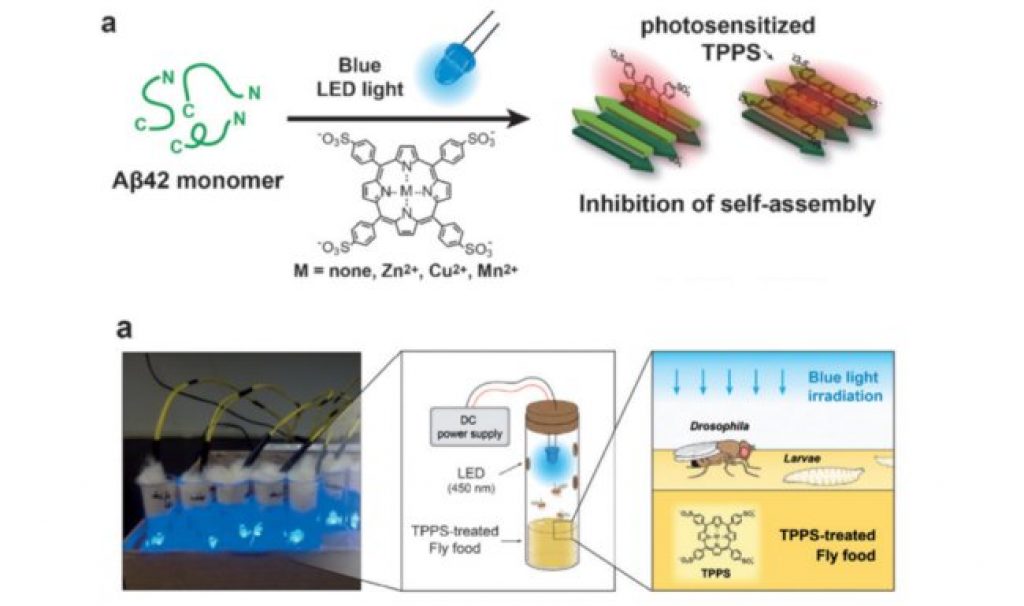
The research team effectively prevented the buildup of beta-amyloids by using blue LED light and a biocompatible organic compound called porphyrin inducer. By absorbing light energy, photosensitizer molecules such as porphyrin can reach an excitation state. When the porphyrin returns to its ground state, active oxygen is released, which then oxidizes a beta-amyloid monomer, thereby disturbing its assembly.
The technique was tested on fruit flies that were modified to model Alzheimer’s disease. The research showed that symptoms of Alzheimer’s disease in the fruit flies—such as damage on synapse and muscle, neuronal apoptosis, degradation in motility, and decreased longevity—were alleviated by blue light treatment.
“This work has significance as it was the first case to use light and photosensitizers to stop deposits of beta-amyloids. We plan to carry the research further by testing compatibility with other organic and inorganic photosensitizers and by changing the subject of photodynamic therapy to vertebrate such as mice.” said Park.
Treatments with light provide additional benefits: less medication is needed and there are fewer side effects. The authors anticipate that photodynamic therapy will be used widely for this reason.
The article can be found at: Lee et al. (2015) Photo-Excited Porphyrins as a Strong Suppressor of ß-Amyloid Aggregation and Synaptic Toxicity.
———
Source: KAIST.
Disclaimer: This article does not necessarily reflect the views of AsianScientist or its staff.