AsianScientist (Oct. 20, 2015) – Researchers from Institute of Biophysics of Chinese Academy of Sciences have proposed that a number may be defined by topology–connectivity between two objects or relationship between surrounding components. Published in Proceedings of the National Academy of Sciences, their work answers the age-old question of how numbers are represented in the brain, and where.
To address how numbers are perceived by the brain, Professor He Lixia and colleagues conducted a number of visual tests on human subjects while imaging their brains. They asked their subjects to estimate the number of dots in a test image compared to a reference image. From there, they changed the way the dots are presented, some with lines connecting several dots while, in another instance, with a shape enclosing two or four dots.
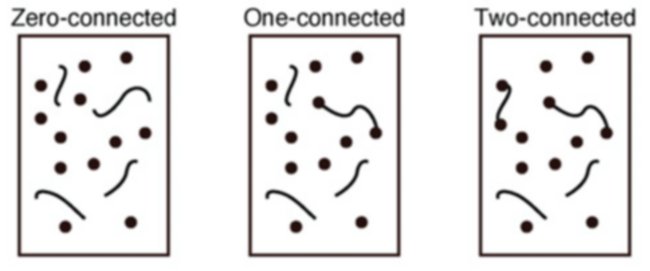
They found that connecting or enclosing the dots robustly and consistently led to underestimation of the number of dots in the test image, with the underestimation increasing with the number of dots connected or enclosed.
The researchers proposed that if the primitive units to be counted are essentially defined by a branch of mathematics known as topology, people can predict some experimental phenomena that are not necessarily consistent with their intuition about numerosity perception, but with topology.
For instance, intuitively, it seems that the inside/outside relationship does not exert fundamental effect on numerosity. However, the topological analysis predicts that enclosing dots, like connecting dots, may lead to numerosity underestimation as multiple dots enclosed within a hollow figure should be perceived as a holistic perceptual unit.
To verify the nature of topological invariance of numerosity, the researchers manipulated the numbers of items connected or enclosed in arbitrary and irregular forms, while controlling low-level features (e.g., orientation, color, and texture density).
They also used subjects which perform discrimination, estimation, equality-judgment, as well as a wide range of presentation-durations and tested small and large numbers. In addition, neural tuning curves to numerosity in the intraparietal sulcus were obtained by using fMRI-adaptation.
The results are consistent with the topological account. Connecting or enclosing items leads to robust numerosity underestimation, and the extent of underestimation increases monotonically with the number of connected or enclosed items. Neural tuning curves to numerosity demonstrate that numbers represented in the intraparietal sulcus are largely determined by topology.
The topological approach contributes to the study of the fundamental philosophical question–what is a number, by means of psychology and neuroscience in a precise and concrete way as shown in this series of behavioral as well as fMRI experiments. The results lead to the intriguing suggestion that numerosity, as a basic invariant property of the environment, may be formally described in terms of topological invariants.
The article can be found at: He et al. (2015) Topology-Defined Units in Numerosity Perception.
———
Source: Chinese Academy of Sciences; Photo: Håkan Dahlström/Flickr/CC.
Disclaimer: This article does not necessarily reflect the views of AsianScientist or its staff.