AsianScientist (Oct. 15, 2015) – The National University of Singapore (NUS) has launched a new research initiative called the NUS Synthetic Biology for Clinical and Technological Innovation (SynCTI) to further develop research capacity and capabilities in the emerging and fast-growing field.
Synthetic biology involves the creation of complex, biologically based or inspired systems, which display functions that do not exist in nature. Potential applications of synthetic biology include biosensing, therapeutics, and the production of biofuels, pharmaceuticals and novel biomaterials.
The global market for synthetic biology is estimated to be more than US$10 billion by 2016. Over the last two years, the Singapore National Research Foundation and Economic Development Board have made concerted efforts to create a conducive environment for synthetic biology to take root and grow in the country by developing local talent in foundational disciplines such as biochemical, metabolic, microbial and genome engineering as well as molecular, structural and systems biology.
“Synthetic biology is one of the most promising fields of modern science with far reaching applications, many of which are still undiscovered and unexplored. NUS’ strong leadership in translational research stands us in good stead to contribute towards developing Singapore as one of the leading synthetic biology hubs in the world,” said Professor Barry Halliwell, who launched the NUS SynCTI initiative.
NUS SynCTI will be helmed by Associate Professor Matthew Chang, who is a faculty member from the Department of Biochemistry at the NUS Yong Loo Lin School of Medicine. Chang has been working in the field of synthetic biology for the past ten years, and has since developed a pioneering approach of reprogramming cells for clinical and industrial applications.
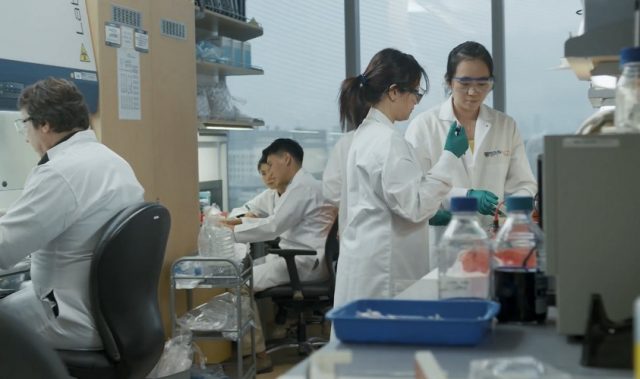
Established with a total funding of about S$25 million (~US$18 million), SynCTI is a multi-disciplinary program comprising more than 60 research staff from the University’s Faculty of Engineering, Faculty of Science and Yong Loo Lin School of Medicine. SynCTI’s work is supported by seven laboratories boasting state-of-the-art equipment, including advanced facilities for Singapore’s only Synthetic Biology Foundry, where biological systems are designed and produced for translational research.
The research activities of SynCTI are organised under six themes, namely the yeast genome project; microbial cell factories; therapeutic cells; bio-lixiviant engineering; mammalian synthetic biology; and cell-free & whole-cell biosensors.
SynCTI also hopes to train 30 post-graduate and undergraduate students each year, and more than 90 synthetic biologists over the next three years.
In line with its emphasis on international research collaboration, SynCTI hosts two joint global synthetic biology laboratories with the University of California, Berkeley—headed by Professor Jay Keasling—and with Imperial College London, led by Professor Paul Freemont. SynCTI has also established two partnerships with Singer Instruments and BD Biosciences to co-develop next generation platforms of synthetic biology applications.
———
Source: National University of Singapore.
Disclaimer: This article does not necessarily reflect the views of AsianScientist or its staff.