AsianScientist (Sep. 3, 2015) – Driven by the limitations of biomimetic glues in wet environments, scientists from Nanyang Technological University (NTU) have invented a glue that will harden when a voltage is applied to it.
This opens a plethora of commercially promising advances such as, using the adhesive to glue metal panels under water, for example, in underwater pipe repairs; replacing sutures when there is a need to join body tissues together during surgery and tailoring the properties of the adhesive to be more gel-like, or rubber-like which would work well in vibrating or damp environments. This research was published in Nature Communications.
The new adhesive, nicknamed ‘Voltaglue,’ opens up a host of possible practical applications, from making underwater repair works for ships and pipes, to being a versatile tool for doctors performing surgery.
In future, surgeons could use biocompatible glue patches to join two pieces of internal body tissue together in one or two minutes, instead of sutures which often require 15 to 20 minutes of careful stitching.
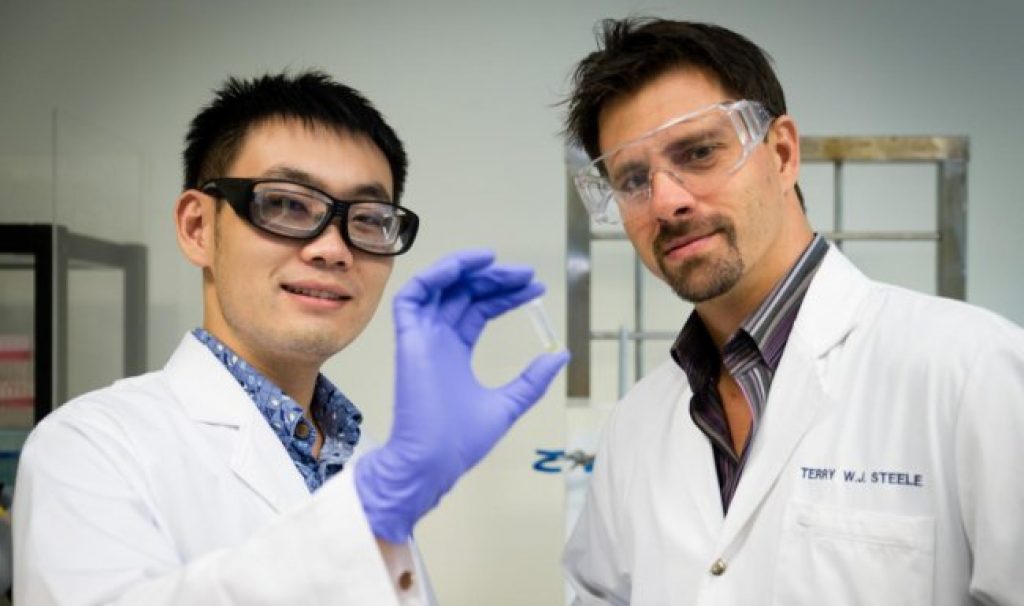
Assistant Professor Terry Steele, the lead scientist for this research project from NTU’s School of Materials Science and Engineering, said it took them over a year to develop an adhesive that could work under wet conditions such as in the human body or underwater.
“Most glues in the market don’t work under wet conditions, much like how sticky tapes won’t work if the surface is wet, since the adhesive will stick to the water instead of the surface,” said Steele.
Usually adhesives such as superglue harden upon contact with moisture in the air. Others like epoxy, often used in electronic mobile devices, has to be baked in high heat of about 150 degrees Celsius, or made using two different chemicals mixed together. These methods are unsuitable in wet environments.
“We had to find a way to make glue which cures (hardens) when we want it without being affected by the environmental conditions, so electricity was the best approach for us. The hardness of our glue can be adjusted by the amount of time we apply a voltage to it, which we call electrocuring.”
This unique electrocuring property allows Voltaglue to be customized for different applications.
“For example, if we are gluing metal panels underwater, we want it hard enough to stick for a long time. However, for medical applications, we want the glue to be more rubber-like so it wouldn’t cause any damage to the surrounding soft tissues,” Steele explained.
Voltaglue is developed using hydrogels consisting of carbon molecules called carbenes grafted onto tree-shaped plastic known as dendrimers.
Upon contact with electricity, the reactive carbenes, which are capable of hooking onto any surface nearby, are released. The amount of “hooks” created depends on how long electricity is applied and how many carbenes are present.
Moving forward, Steele and his team of 11 researchers are working to improve their new electrocuring glue so it can harden in just a few seconds, compared to about 30 seconds now; and also working on a way to undo the process.
The article can be found at: Ping et al. (2015) Adhesive curing through low-voltage activation.
———
Source: Nanyang Technological University.
Disclaimer: This article does not necessarily reflect the views of AsianScientist or its staff.