AsianScientist (Aug. 5, 2015) – The concept of walking on water might sound supernatural, but in fact it is a quite natural phenomenon. Many small living creatures leverage water’s surface tension to maneuver themselves around.
One of the most complex maneuvers, jumping on water, is achieved by a species of semi-aquatic insects called water striders that not only skim along water’s surface but also generate enough upward thrust with their legs to launch themselves airborne from it.
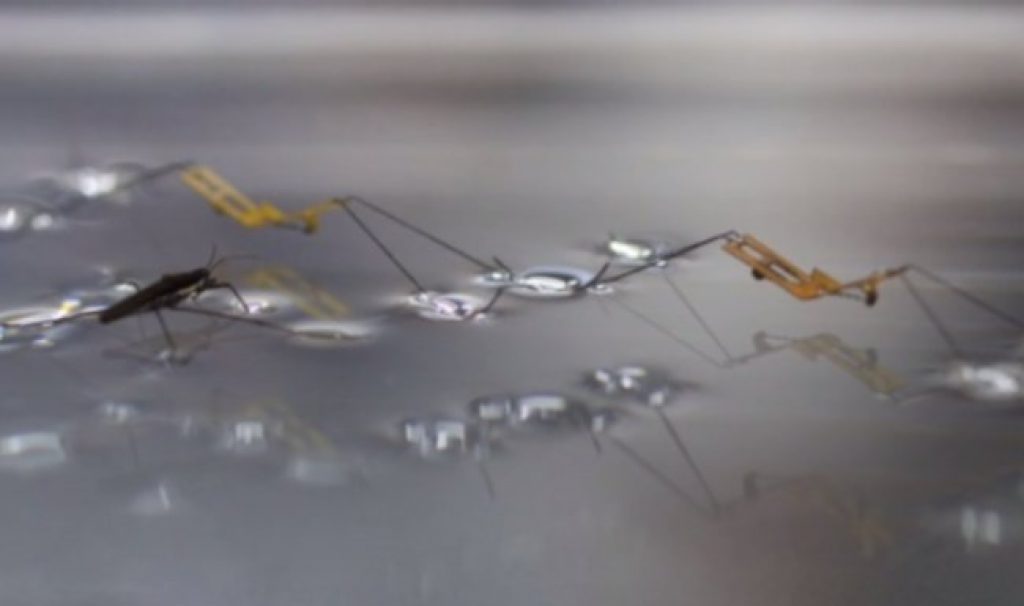
Now, emulating this natural form of water-based locomotion, an international team of scientists from Seoul National University (SNU) and Harvard’s Wyss Institute for Biologically Inspired Engineering has unveiled a novel robotic insect that can jump off of water’s surface.
Their work, published in Science, reveals new insights into the natural mechanics that allow water striders to jump from rigid ground or fluid water with the same amount of power and height.
“Water’s surface needs to be pressed at the right speed for an adequate amount of time, up to a certain depth, in order to achieve jumping,” said the study’s co-senior author Cho Kyu Jin, an associate professor at Seoul National University. “The water strider is capable of doing all these things flawlessly.”
The water strider, whose legs have slightly curved tips, employs a rotational leg movement to aid it its takeoff from the water’s surface, said co-senior author SNU Professor Kim Ho-Young. Kim, a former Wyss Institute Visiting Scholar, worked with the study’s co-first author Eunjin Yang, a graduate researcher at SNU’s Micro Fluid Mechanics lab, to collect water striders and take extensive videos of their movements to analyze the mechanics that enable the insects to skim on and jump off water’s surface.
It took the team several trial and error attempts to fully understand the mechanics of the water strider, using robotic prototypes to test and shape their hypotheses.
“If you apply as much force as quickly as possible on water, the limbs will break through the surface and you won’t get anywhere,” said Dr. Robert Wood, co-author on the study from the Wyss Institute.
But by studying water striders in comparison to iterative prototypes of their robotic insect, the SNU and Harvard team discovered that the best way to jump off of water is to maintain leg contact on the water for as long as possible during the jump motion.
“Using its legs to push down on water, the natural water strider exerts the maximum amount of force just below the threshold that would break the water’s surface,” said the study’s co-first author Dr. Koh Je-Sung Koh, who was pursuing his doctoral degree at SNU during the majority of this research and is now a Postdoctoral Fellow at the Wyss Institute and the Harvard Paulson School.
Mimicking these mechanics, the robotic insect built by the team can exert up to 16 times its own body weight on the water’s surface without breaking through, and can do so without complicated controls. Many natural organisms such as the water strider can perform extreme styles of locomotion—such as flying, floating, swimming, or jumping on water—with great ease despite a lack of complex cognitive skills.
“This is due to their natural morphology,” said Cho. “It is a form of embodied or physical intelligence, and we can learn from this kind of physical intelligence to build robots that are similarly capable of performing extreme maneuvers without highly-complex controls or artificial intelligence.”
The robotic insect uses a burst of momentum coupled with limited thrust to propel itself off the water without breaking the water’s surface. An automatic triggering mechanism, built from composite materials and actuators, was employed to activate the catapult.
To produce the body of the robotic insect, ‘pop-up’ manufacturing was used to create folded composite structures that self-assemble much like the foldable components that ‘pop-up’ in 3D books. This ingenious layering and folding process enables the rapid fabrication of microrobots and a broad range of electromechanical devices.
“The resulting robotic insects can achieve the same momentum and height that could be generated during a rapid jump on firm ground—but instead can do so on water—by spreading out the jumping thrust over a longer amount of time and in sustaining prolonged contact with the water’s surface,” said Wood.
The article can be found at: Koh et al. (2015) Jumping On water: Surface Tension–Dominated Jumping of Water Striders and Robotic Insects.
———
Source: The Wyss Institute for Biologically Inspired Engineering.
Disclaimer: This article does not necessarily reflect the views of AsianScientist or its staff.