AsianScientist (May 29, 2015) – A University of Tokyo research group has successfully identified a microstructural unit that controls liquid-liquid transition between two phases in a single substance with multiple liquid phases. Identifying this unit is key to understanding liquid-liquid transitions. Their findings have been published in Proceedings of the National Academy of Sciences.
It is widely known that even a single-component substance can have more than two crystals, as in the case of carbon (diamond and graphene) and water. Contrarily, it was thought that as a liquid is a disordered state there is only one liquid state for a single-component substance. Liquid-liquid transition in such single-component substances has attracted considerable attention as a new type of phase transition, overturning the conventional view of liquids.
However, although much evidence suggestive of its presence has been gathered, the existence of liquid-liquid transitions is still an ongoing debate due to experimental difficulties. To prove the existence of liquid-liquid transitions, it is necessary to experimentally identify the micro structure governing liquid-liquid transition on a microscopic level.
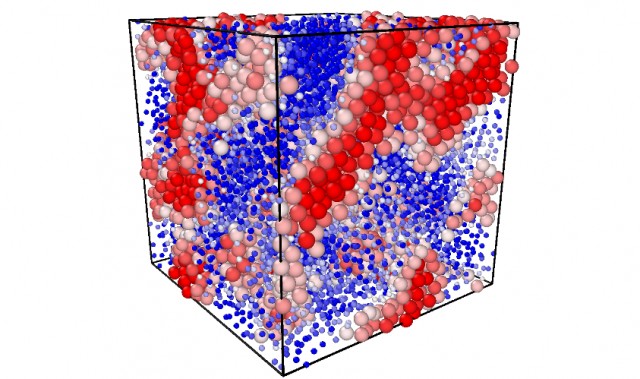
Professor Hajime Tanaka’s research group at the Institute of Industrial Science have successfully identified a structural unit that controls a liquid-liquid transition by using an organic liquid, triphenyl phosphite, which has a transition under ambient pressure. The research group observed the target liquid by irradiating it with X-rays and found that the new liquid formed after the transformation has a higher density of clusters composed of several molecules.
“A liquid state is one of the fundamental states of matter besides gas and solid and an important physical state universal to a wide range of materials including metals, semiconductors and organic materials,” said Tanaka.
Thus, our finding not only contributes to our understanding of the underlying mechanism of liquid-liquid transition, but also provides a new insight into the liquid phase, which has been believed to be uniform and random and leads to a deeper understanding of the very nature of the liquid state.”
The article can be found at: Murata et al. (2015) Microscopic Identification Of The Order Parameter Governing Liquid–liquid Transition In A Molecular Liquid.
———
Source: The University of Tokyo.
Disclaimer: This article does not necessarily reflect the views of AsianScientist or its staff.