AsianScientist (Apr. 1, 2015) – Researchers have built a 50kg-class micro satellite that can communicate half as fast as a two ton satellite. Their results have been published in Space, Aeronautical and Navigational Electronics.
Micro satellites have been used to observe the Earth’s surface with high resolution and detect objects of at least a few meters. These small satellites, however, cannot send large quantities of image data the ground station due to power and mass constraints.
The research group of Professor Hirobumi Saito, of the Institute of Space and Astronautical Sciences (ISAS) and the University of Tokyo, has developed novel technologies that enable the use of high speed on-board transmitters that consume less power and the associated ground-based technologies for reception of the transmitted data.
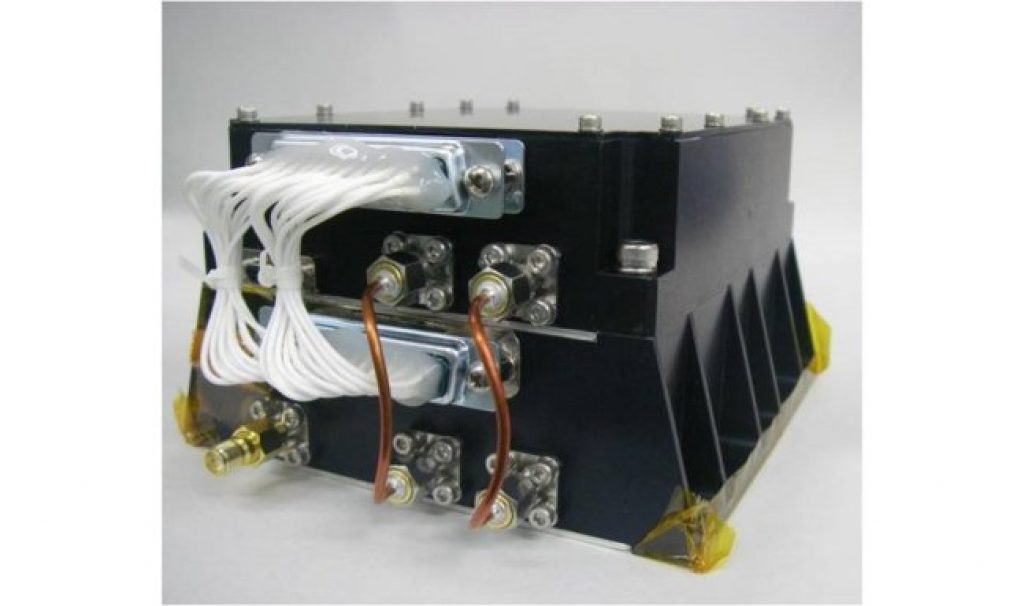
Together with the group of Professor Shinichi Nakasuka in the University of Tokyo Graduate School of Engineering, the team developed the flight model of the X-band high speed transmitter for the small satellite “Hodoyoshi-4”.
In December 2014, the 3.8m antenna station at ISAS received data at 348 megabits per second (Mbps) with 16 quadrature amplitude modulation (QAM) and successfully demodulated/decoded the data without error. This communication speed is roughly half that of Daichi 2, a Japanese earth observation satellite with a mass of two tons, and as of February 2015 is the world’s fastest as a 50kg class micro satellite.
This research demonstrates that the data transmission capabilities of small satellites is approaching that of large satellites. However, issues such as the improvement of optical and radar sensor capabilities remain to be resolved.
The article can be found at: Fukami et al. (2015) On-Orbit Demonstration of the X-band 348 Mbps Communication System for the Nano Satellite: Hodoyoshi-4.
———
Source: University of Tokyo.
Disclaimer: This article does not necessarily reflect the views of AsianScientist or its staff.