AsianScientist (Apr. 17, 2015) – Researchers have developed an nanotechnology that can deliver anti-cancer drugs uniformly to an entire tumor. Their results were published in Nano Letters.
To treat inoperable tumors, anti-cancer medicine is commonly used. However, efficient drug delivery to tumor cells is often difficult, treating an entire tumor with drugs even more so.
Existing drug delivery systems can only deliver drugs to tumor cells near blood vessels, leaving cells at the heart of a tumor intact. Since most drugs are injected into the bloodstream, tumor recurrence post medication is frequent.
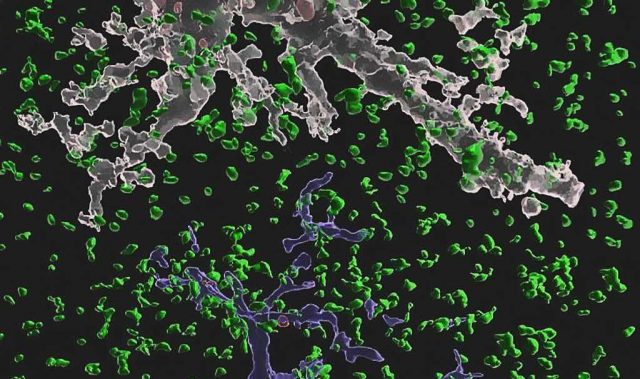
Therefore, a team of researchers at the Korea Advanced Institute of Science and Technology (KAIST) used liposomes that can fuse to the cell membrane and enter the cell. Once inside liposomes, the drug can travel into the bloodstream and enter tumor cells near blood vessels where they are loaded to exosomes. Since exosomes can travel between cells, the drug can be delivered efficiently into inner cells of the tumor.
Exosomes, which are secreted by cells that exist in the tumor microenvironment, are known to have an important role in tumor progression and metastasis since they transfer biological materials between cells. The research team started the investigation recognizing the possibility of delivering the anti-cancer drug to the entire tumor using exosomes.
The team led by KAIST’s Professor Park Ji-Ho injected a light-sensitive anti-cancer drug using their new delivery technique into mice. They then applied light to the tumor site to activate the anti-cancer treatment and analyzed a tissue sample. They observed the effects of the anti-cancer drug in the entire tumor tissue.
The team’s results demonstrate that drug delivery can be tailored to specific diseases by understanding its microenvironment. The work paves the way to more effective drug delivery systems for many chronic diseases, including cancer tumors that were difficult to treat due to the inability to penetrate deep into the tissue.
The team is currently conducting experiments with other anti-cancer drugs which are being developed by pharmaceutical companies, using their tumor-penetrating drug delivery nanotechnology to identify its effects on malignant tumors.
The article can be found at: Lee et al. (2015) Liposome-Based Engineering of Cells To Package Hydrophobic Compounds in Membrane Vesicles for Tumor Penetration.
—–
Source: KAIST.
Disclaimer: This article does not necessarily reflect the views of AsianScientist or its staff.