
AsianScientist (Jan. 30, 2015) – It’s still the Lunar New Year as I write this. As far as starting the New Year goes, this is the start of new beginnings. I am three months away from finishing graduate school, and naturally, I have been doing some thinking about, well, the Future. The Future of Mankind, specifically. I can think about my own future later.
As a child, my first professional goal was to be an astronaut/mathematician/poet extraordinaire (I invented the “slasher” category). I am no closer to any of those careers than I am to becoming the Queen Overlord of the Universe. However, I am still fascinated with space, and humanity’s capacity to deal with interplanetary travel.
Space has clearly always captured the imagination of humans. With the advent of the “Star Wars” movies in the 1970s to the recent “Gravity” and “Interstellar”, it’s fairly obvious that we are still very interested in exploring the great beyond.
But at what economic and human cost?
Funding heads East
Back in the Space Age, the US and Russian governments were the key players in providing funding for space exploration. Under the Obama administration, the US government has cut back on space exploration significantly—from 4.41 percent of the federal budget in 1967 to 0.5 percent in 2014, according to NASA. The American shuttle program ended in 2011. At present, Russia alone now is responsible for the manning of the International Space Station (ISS).
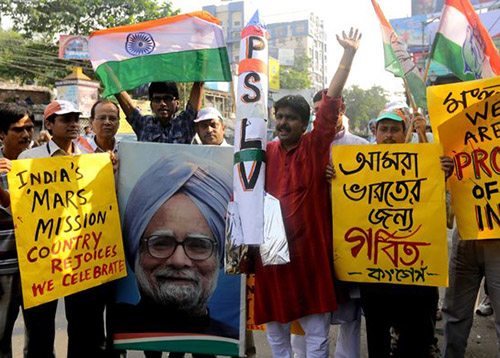
Recently, in a flamboyant show of economic muscle flexing, China has stepped up in its space exploration budget, sending its first citizen into space in October 2003. Similarly, India has made great strides in space exploration. In 2014, the Indian Space Research Organization sent a Geostationary Launch Vehicle (GSLV) into Martian orbit. Remarkably, it was also £365 million (~US$563 million) cheaper than the American Maven mission. India is now apparently only ten years away from a manned space mission, a remarkable feat for a country that is still associated with images of urban slums and poverty.
Should the private sector step in?
It is difficult to imagine space travel as a normative form of travel. However, entrepreneur extraordinaire Sir Richard Branson is on the quest to “democratize space travel” with his space travel agency Virgin Galactic. Currently, the agency’s capacity is limited to human suborbital spaceflight. This involves launching a shuttle beyond the Earth’s atmosphere for the traveller to encounter true weightlessness, and to view the Earth from up above. The traveller then prepares for re-entry after this experience. Sir Richard is contemplating orbital space flights and moon hotels. However, with the crash of Virgin’s SpaceShipTwo last October, it seems that plans for further space tourism have been set back.
Sir Richard’s bold endeavors have been likened to that of Sir Walter Raleigh’s desire to explore the New World in the Elizabethan era, where the risks are absurdly high and the chances of success are nominally small. Now that Western governments have cut back on space travel, other private companies in addition to Virgin such as SpaceX and Orbital Sciences Corp have surfaced in the quest to “colonize” space. SpaceX has even been contracted by the US government to send astronauts to the ISS by 2017.
According to NASA, on average, it costs US$450 million to launch a space shuttle. The future of space tourism and democratic space travel for an average Earth citizen seems nascent at best. It is unclear at the moment how the space industry will play out, as there are no previous business models to draw lessons from. However, we can all conclude one thing about the space travel industry for sure: it will be extremely expensive to go have an “out of this world” holiday.
This article is from a monthly column called Our Small World. Click here to see the other articles in this series.
——-
Copyright: Asian Scientist Magazine; Photo: Shutterstock.
Disclaimer: This article does not necessarily reflect the views of AsianScientist or its staff.