AsianScientist (Dec. 12, 2014) – Using high-speed cameras, scientists have uncovered the sophisticated wing-folding patterns of rove beetles. Published in the Proceedings of the National Academy of Science, the finding could inspire the design of self-deployable structures.
The artful wing folding of insects has not only attracted entomologists but also researchers in aerospace and mechanical engineering. In rove beetles, a set of hardened forewings known as the elytra act as a cover for the soft hindwings, leaving the abdomen exposed and freely movable. This arrangement necessitates hindwings that are more compact than those of other beetles.
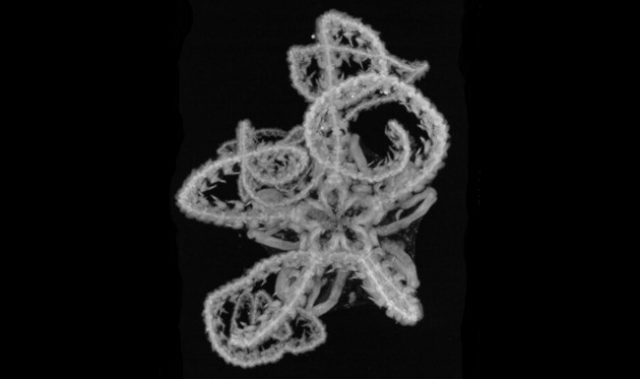
To cope with the space constraints, rove beetles have a complex, asymmetrical folding pattern that allows them to quickly deploy their wings. However, the specific folding process and the reason for asymmetry remain unclear.
Using a high-speed camera, a team led by assistant professor Kazuya Saito from the University of Tokyo has revealed the details of the take-off and wing-folding movement of the rove beetle Cafius vestitus, known for its flying ability.
The results show that the characteristic asymmetrical patterns emerge as a result of simultaneous folding of overlapped wings. The revealed folding mechanisms can achieve not only highly compact wing storage but also immediate deployment. In addition, the right and left crease patterns are interchangeable, thus each wing internalizes two crease patterns and can be folded in two different ways. This two-way folding gives rove beetles freedom of choice for the folding direction.
The use of asymmetric patterns and the capability of two-way folding are unique features not found in artificial structures. They have great potential to extend the design possibilities for all deployable structures, from space structures such as the solar panels on satellites to articles of daily use such as umbrellas and folding fans.
The article can be found at: Saito et al. (2014) Asymmetric Hindwing Foldings in Rove Beetles.
——
Source: University of Tokyo.
Disclaimer: This article does not necessarily reflect the views of AsianScientist or its staff.