AsianScientist (Nov. 19, 2014) – Scientists have solved the puzzle of how slime molds manage to move in a sustained direction in response to waves of chemoattractants. This research has been published in Nature Communications.
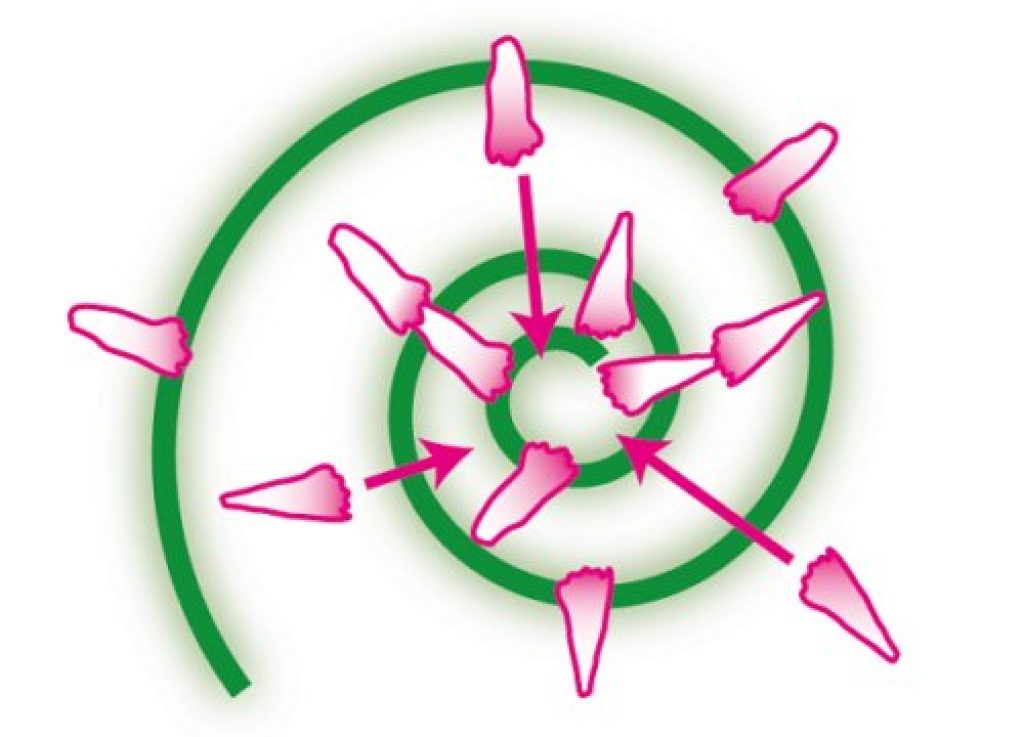
The cellular slime mold Dictyostelium discoideum, a social amoeba, has a unique life cycle characterized by a unicellular growth stage and a multicellular fruiting body formed by cell aggregation. The signal for cells to aggregate is in the form of propagating waves of attractant molecules and cells move in the direction of increasing concentration.
However, because the attractant molecules propagate in the form of waves, the back of the wave provides a negative gradient that could potentially give rise to reverse cell movement. This conundrum has been known as wave “chemotaxis paradox”. How cells managed to move in one direction without being confused by this falling concentration remained unknown.

To address this question, a research group lead by Associate Professor Satoshi Sawai at the University of Tokyo Graduate School of Arts and Sciences focused on the internal cellular response to an external signal. When an external signal to aggregate is perceived, an internal signal is released from the edge of the cell. The group discovered that this internal response in Dictyostelium cells is repressed when the stimulus decreases over a period of five to six minutes.
The team has shown that this signal processing property—known as ‘rectification’—is best explained by an adaptive gradient sensing mechanism coupled to a strong suppressive signal. This finding was made possible by combining technologies enabling high-precision laminar flow control in microchannels and quantitative measurement of intracellular reactions, and verification by theoretical models.
According to Prof. Sawai, the mechanism hints at how other moving cells such as immune cells combine more complex temporal and spatial cues in our tissues to determine their movement. This result will be of great importance in understanding and developing procedures for controlling the mechanisms of cell migration in immune response, wound healing and animal development including humans.
The article can be found at: Nakajima et al. (2014) Rectified Directional Sensing in Long-Range Cell Migration.
——-
Source: University of Tokyo.
Disclaimer: This article does not necessarily reflect the views of AsianScientist or its staff.