AsianScientist (Oct. 8, 2014) – Researchers from École Polytechique Fédérale de Lausanne (EPFL) and Nanyang Technological University have developed an efficient and cheap way to split water into hydrogen and oxygen, achieving an unprecedented efficiency of 12.3 percent. Their results, published in Science, could eliminate the need for rare-earth metals in the production of usable hydrogen fuel.
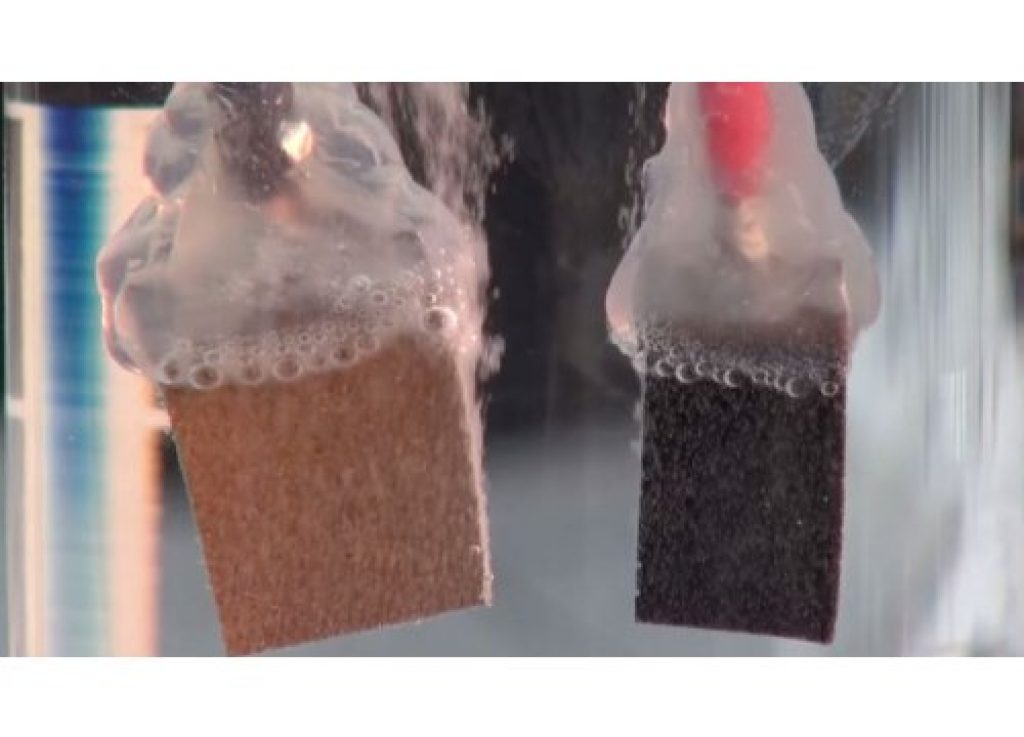
Led by Professor Michael Grätzel, who invented dye solar cells that mimic photosynthesis in plants, the research team combined electricity-generating cells with an electrolyzer that separates the water molecules. Using this device, post-doctoral student Luo Jingshan and his colleagues were able to convert 12.3 percent of the energy captured by the perovskite absorbers into energy used to generate hydrogen. In contrast, photosynthesis in the natural world has an efficiency of about one percent.
This high efficiency provides stiff competition for other techniques used to convert solar energy. In addition, the new method has several advantages over others, including the ability to rapidly scale up to meet the world’s energy need since rare-earth metals are not required.
“Both the perovskite used in the cells and the nickel and iron catalysts making up the electrodes require resources that are abundant on Earth and that are also cheap,” explained Mr. Luo. “However, our electrodes work just as well as the expensive platinum-based models customarily used.”
On the other hand, the conversion of solar energy into hydrogen makes its storage possible, which addresses one of the biggest disadvantages faced by renewable electricity.
“Once you have hydrogen, you store it in a bottle and you can do with it whatever you want to, whenever you want it,” said Prof. Grätzel.
Such a gas can indeed be burned, releasing only water vapor. It can also pass into a fuel cell to generate electricity on demand. And the 12.3% conversion efficiency achieved at EPFL “will soon get even higher,” promised Grätzel.
These high efficiency values are based on a characteristic of perovskite cells: their ability to generate an open circuit voltage greater than 1 V (silicon cells stop at 0.7 V, for comparison).
“A voltage of 1.7 V or more is required for water electrolysis to occur and to obtain exploitable gases,” explained Mr. Luo.
To get these numbers, three or more silicon cells are needed, whereas just two perovskite cells are enough. As a result, there is more efficiency with respect to the surface of the light absorbers required.
“This is the first time we have been able to get hydrogen through electrolysis with only two cells!” Luo adds.
The article can be found at: Luo et al. (2014) Water Photolysis at 12.3% Efficiency via Perovskite Photovoltaics and Earth-abundant Catalysts.
——-
Source: École Polytechique Fédérale de Lausanne.
Disclaimer: This article does not necessarily reflect the views of AsianScientist or its staff.