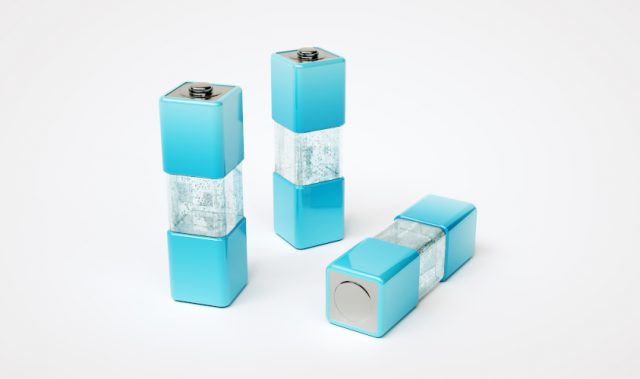
AsianScientist (Sep. 23, 2014) – A fevered search for the next great high-energy, rechargeable battery technology is on. Scientists are now reporting they have overcome key obstacles toward making lithium-sulfur (Li-S) batteries, which have the potential to leave today’s lithium-ion technology in the dust. Their study appears in the journal Nano Letters.
Drs. Xiao Xingcheng, Zhou Weidong, Cai Mei and their colleagues point out that the capabilities of lithium-ion batteries, which power many of our consumer electronics, as well as electric vehicles, have largely plateaued. Scientists have been pursuing a number of new battery technologies to topple today’s standard. One heavy focus has been on a key battery component that is currently made out of a metal oxide.
Some researchers have been trying to replace the metal oxide with cheaper and lighter sulfur, to make Li-S batteries. In theory, this could allow batteries to pack five to eight times the energy of existing technology. One of the main problems with this approach, however, is that Li-S compounds escape from where they’re supposed to be, which causes the battery to lose charge quickly. The team set out to find a way to contain the errant compounds.
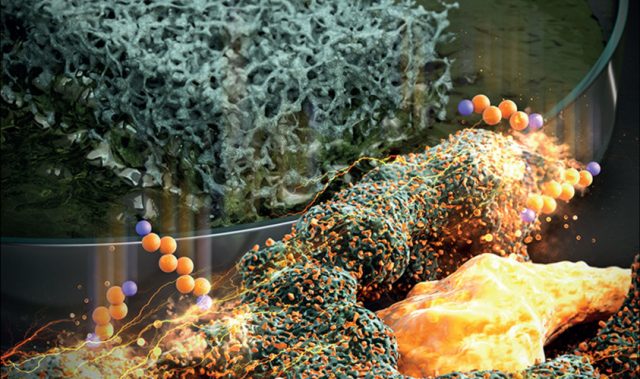
To solve this problem, the researchers made tiny, hollow shells out of carbon, which is conductive. They then coated them with a polymer to help confine the Li-S compounds inside. When tested, the structures kept up a high-energy storage capacity (630 mAh/g versus less than 200 mAh/g of lithium-ion batteries) over 600 cycles of fast charging and discharging.
“These results provide promising insights and novel concepts for future sulfur-based batteries,” the researchers conclude.
The article can be found at: Zhou et al. (2014) Polydopamine-Coated, Nitrogen-Doped, Hollow Carbon–Sulfur Double-Layered Core–Shell Structure for Improving Lithium–Sulfur Batteries.
——-
Source: American Chemical Society; Photo: bitslammer/Flickr/CC.
Disclaimer: This article does not necessarily reflect the views of AsianScientist or its staff.