AsianScientist (Sep. 18, 2014) – Cooperation between cells of the innate immune system could play an important role in the body’s defense against cancer, according to a study recently published in the journal eLife.
Cancer immunotherapy is an emerging field which seeks to harness the immune system in treating cancer. So far, much research has centered around the use of the adaptive immune system such as T and B cells. The involvement of the innate immune system—which acts more quickly and is thought to be less sophisticated than adaptive immunity—remains unknown.
In the present study, researchers led by Professor Tadatsugu Taniguchi, director of the Max Planck-University of Tokyo Center for Integrative Inflammology at the University of Tokyo, have shown that the innate immune system also plays a role in recognizing tumor cells.
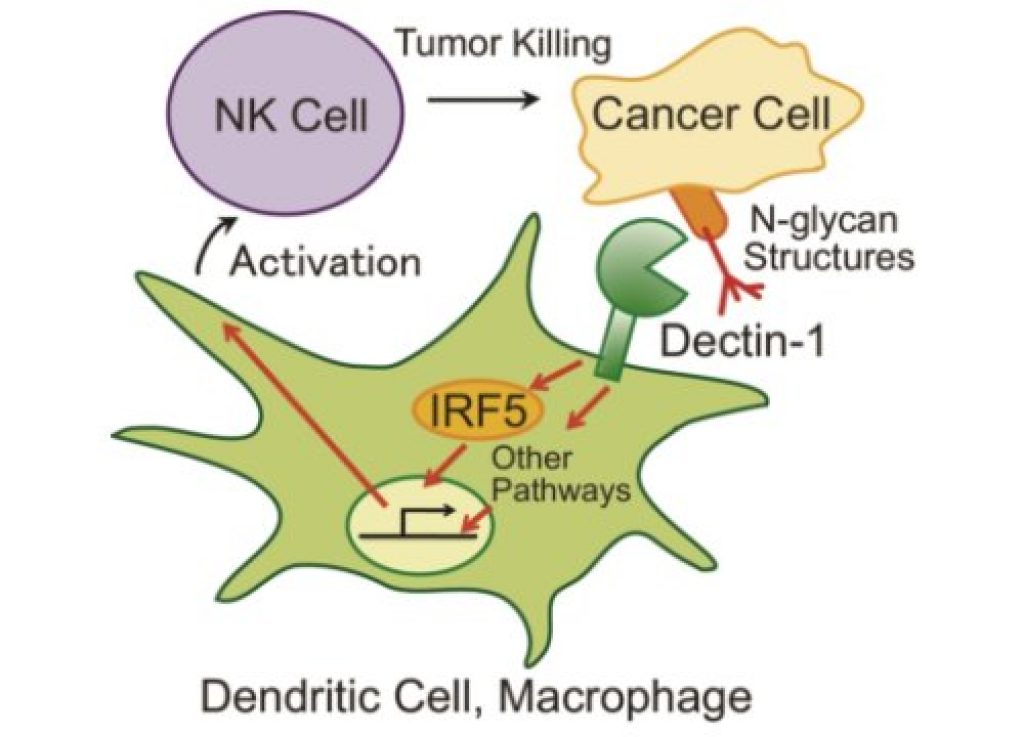
They found that Dectin-1, an innate immune receptor found on the surface of cells such as macrophages and dendritic cells, recognizes structures that are overexpressed on tumor cells. Through signaling via the IRF5 pathway, Dectin-1 bearing cells then instruct natural killer (NK) cells, directing them to kill the tumor. This study is the first to report an innate immune receptor that can contribute to tumor recognition.
Apart from suggesting new avenues of cancer immunotherapy, the study also raises interesting questions about whether Dectin-1 signaling influences the adaptive immunity’s response to tumor cells and whether the ligands of Dectin-1 represent a new class of tumor-associated molecular patterns (TAMPs) analogous to the existing pathogen-associated molecular patterns (PAMPs) and danger-associated molecular patterns (DAMPs).
The article can be found at: Chiba et al. (2014) Recognition of Tumor Cells by Dectin-1 Orchestrates Innate Immune Cells for Anti-Tumor Responses.
——-
Copyright: Asian Scientist Magazine; Photo: Tadatsugu Taniguchi/University of Tokyo.
Disclaimer: This article does not necessarily reflect the views of AsianScientist or its staff.