AsianScientist (Sep. 19, 2014) – Researchers have discovered a new bottom-up fabrication method that produces defect-free graphene nanoribbons (GNRs) with periodic zigzag-edge regions. This method, which controls GNR growth direction and length distribution, is a stepping stone towards future graphene-device fabrication by self-assembly. The study documenting these findings has been published in ACS Nano.
With its high stability, strength, and charge-carrier mobility, graphene promises to be a revolutionary material for making next-generation high-speed transistors. Moreover, graphene’s properties are predicted to be directly controllable by its structure. For example, recent research has demonstrated that the bandgap of armchair GNRs is controlled by the ribbon width. However, controlling other properties via graphene structure has not been tested, because of the difficulty of producing defect-free graphene.
“Previous strategies in bottom-up molecular assemblies used inert substrates, such as gold or silver, to give molecules a lot of freedom to diffuse and react on the surface,” said first author Assistant Professor Patrick Han from the Advanced Institute of Materials Research (AIMR), Tohoku University. “But this also means that the way these molecules assemble is completely determined by the intermolecular forces and by the molecular chemistry.”
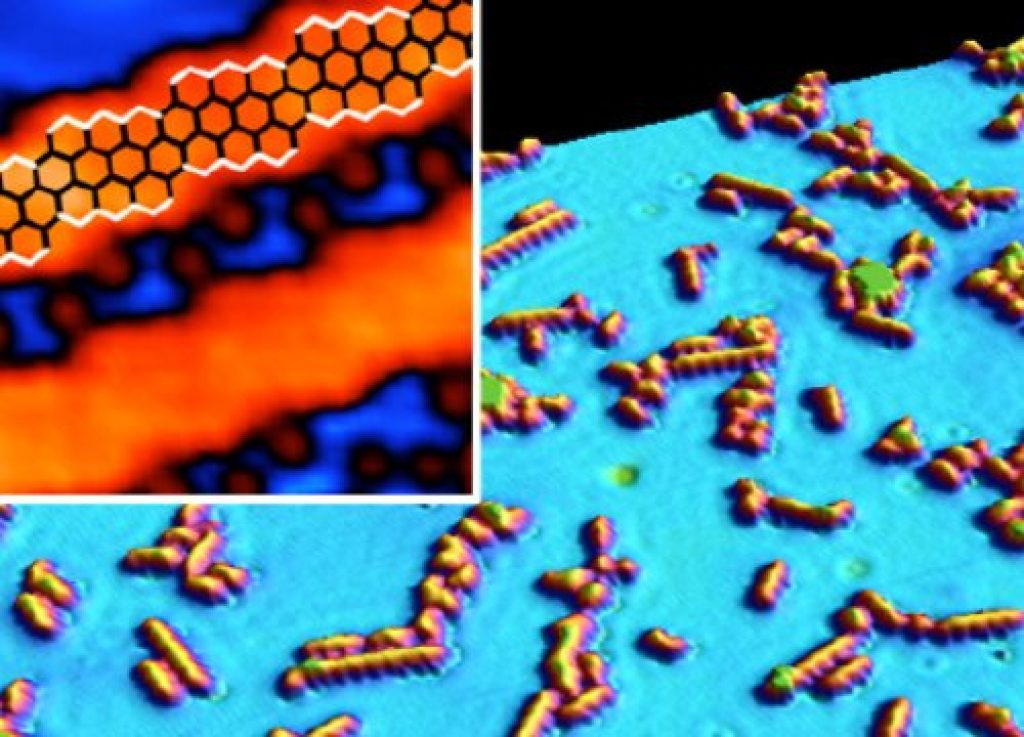
In order to produce a zigzag edge, the AIMR team used a copper surface to introduce new substrate-to-molecule and intermolecular interactions. On copper, scanning tunneling microscope images revealed a molecular assembly that is entirely different from that on gold or silver, which are used as inert substrates in other bottom-up fabrication methods.
Moreover, the surface reactivity of the copper substrate also had a profound effect on both the GNR length distribution and surface growth direction, producing shorter ribbons. These features could be exploited for making single graphene interconnections between prefabricated structures by self-assembly.
“Diffusion-controlled assemblies, as seen on gold and silver, produce bundles of long GNRs. These methods are good for making interconnect arrays, but not single connections”, Prof. Han says. “Our method opens the possibility for self-assembling single graphene devices at desired locations, because of the length and of the direction control.”
Future directions include the assessment of other reactive surfaces for bottom-up GNR fabrication, and the determination of the property-tailoring effects of the GNR edges.
The article can be found at: Han et al. (2014) Bottom-Up Graphene-Nanoribbon Fabrication Reveals Chiral Edges and Enantioselectivity.
——
Source: Advanced Institute for Materials Research, Tohoku University.
Disclaimer: This article does not necessarily reflect the views of AsianScientist or its staff.