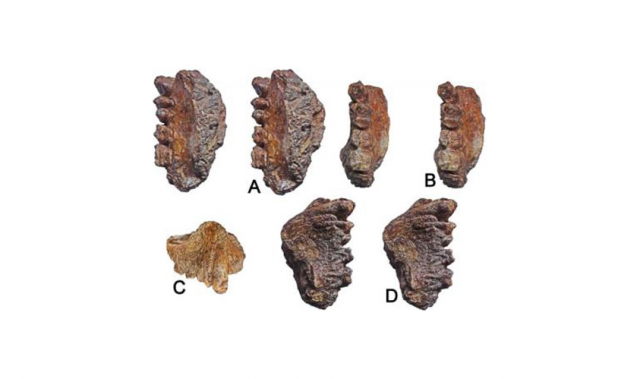
AsianScientist (Aug. 28, 2012) – Researchers have recovered an ancient skull from a cave in the Annamite Mountains in northern Laos which they believe is the oldest modern human fossil in Southeast Asia.
The researchers, who had found the skull in 2009, are likely the first to dig for ancient bones in Laos since the early 1900s, when a team found skulls and skeletons of several modern humans in another cave in the Annamite Mountains.
Those fossils were about 16,000 years old, much younger than the recently found skull, which dates to between 46,000 and 63,000 years old.
“It is a particularly old modern human fossil and it is also a particularly old modern human for that region,” said University of Illinois anthropologist Laura Shackelford, who led the study with anthropologist Fabrice Demeter, of the National Museum of Natural History in Paris.
“There are other modern human fossils in China or in Island Southeast Asia that may be around the same age but they either are not well dated or they do not show definitively modern human features. This skull is very well dated and shows very conclusive modern human features,” she said.
Since no other artifacts have yet been found with the skull, it suggests that the cave was not a dwelling or burial site, but more likely that a person died outside and the body was washed into the cave sometime later.
The discovery reveals that early modern human migrants did not follow the coast and go south to the islands of Southeast Asia and Australia, as some researchers have predicted; they also traveled north into very different types of terrain.
It also indicates that ancient wanderers out of Africa left the coast and inhabited diverse habitats much earlier than previously established.
“This find supports an ‘Out-of-Africa’ theory of modern human origins rather than a multi-regionalism model. Given its age, fossils in this vicinity could be direct ancestors of the first migrants to Australia,” Shackelford said.
The discovery also bolsters genetic studies that indicate that modern humans occupied that part of the world at least 60,000 years ago, she added.
Using radiocarbon dating and luminescence techniques, the researchers determined the age of the soil layers above, below, and surrounding the skull, which was found nearly 2.5 meters below the surface of the cave.
Researchers at Illinois used uranium/thorium dating to determine the age of the skull, which they determined was about 63,000 years old. These techniques measure the energy retained in crystalline particles in the soil to determine how much time has elapsed since the soil was last exposed to heat or solar radiation.
It was found that the layer of soil surrounding the fossil had washed into the cave between 46,000 and 51,000 years ago.
“Those dates are a bit younger than the direct date on the fossil, which we would expect because we do not know how long the body sat outside the cave before it washed in,” Shackelford said.
“This fossil find indicates that the migration out of Africa and into East and Southeast Asia occurred at a relatively rapid rate, and that, once there, modern humans were not limited to environments that they had previously experienced. We now have the fossil evidence to prove that they were there long before we thought they were there,” she added.
The findings have been published in the Proceedings of the National Academy of Sciences, and can be found at: Demeter F et al. (2012) Anatomically modern human in Southeast Asia (Laos) by 46 ka.
——
Source: UIUC; Photo: Laura Shackelford.
Disclaimer: This article does not necessarily reflect the views of AsianScientist or its staff.