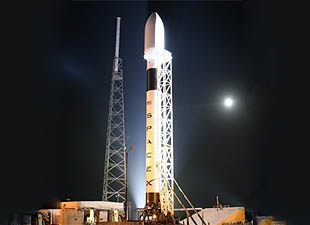
AsianScientist (Feb. 13, 2012) – Vega, the newest rocket from French company Arianespace, lifted-off at 10:00 AM (GMT) from the European Space Agency’s launch center in Kourou, French Guiana.
Carrying nine light-weight satellites on its maiden flight, Vega completes Arianespace’s trinity of rockets at French Guiana by complementing the heavy-lifter Ariane 5, and the mid-range Soyuz.
Just four days earlier, we chatted with Arianespace’s ASEAN Director, Mr. Richard Bowles, at the Global Space & Technology Convention (GSTC) 2012, which took place from February 9 to 10 at the Sheraton Towers in Singapore.
Asian Scientist Magazine asked Mr. Bowles for his thoughts on Vega’s maiden launch, Arianespace’s potential competition from American start-up SpaceX, and the company’s plans for the Asian market.
Arianespace expects 2012 to be its busiest year in recent times with a family of three launchers – Ariane 5, Soyuz, and Vega. Considering this what are some of the challenges the company expects to face?
The first challenge will be to successfully launch the Vega launcher as it has never flown before. All launches are maiden flights because every vehicle flies only once, but Vega has never flown before, so we have no experience.
With rockets, at the end of the day you can never test everything. You can simulate, you can look at its heritage, but the proof is in its launch. So the challenge is, can we achieve a launch without any problems. The failure rate for first launches is 30 percent, and that’s significant. We have launched Ariane 5 now for nine years with zero failure, so that’s the objective at the end.
Other challenges for Arianespace: In 2011, we launched five Ariane 5’s, and we hope to launch up to seven Ariane 5’s this year, and a number of Soyuz. We never had three launchers at the same site before. There are a lot of firsts in 2012.
Is the Vega launch campaign progressing on schedule for the much-awaited February 13 launch? How many potential customers has this new rocket attracted so far?
I’m not aware of any problems at the moment, but as you get closer and closer to the lift-off, more of the elements of the launch are being engaged, and the probability and possibility of a problem occurring increases closer to the launch. Today is the 9th, so we have another few days. There are no known problems as of today.
Altogether, we have a dozen payloads identified for Vega launchers; most of them from the European Space Agency, for European agencies.

Can you say something about the third Automated Transfer Vehicle (ATV) launch in March to the International Space Station (ISS)?
At the latest reports, everything is moving smoothly, it is planned for March 9th. Regarding that launch, it is a significant technical challenge because we have to launch to the second. In geostationary orbit, things end up being stationary; Here, we have the International Space Station traveling at seven kilometers per second.
If we miss the window, we have to wait until the next day to launch. Unlike commercial communications satellites, we have a window of one hour if there is bad weather, a hiccup. If there is an electrical storm at the second we launch the ATV, we have to launch the next day instead.
What is Arianespace’s plan for the Asian region, in particular for India and China?
We do not have any activities at all in China, excluding Hong Kong. There are all sorts of constraints, but primarily, China does have the intention of being self-sufficient, and therefore doesn’t have an open commercial market. We have never been consulted by any Chinese operators for a launch.
And even if they were interested, they probably wouldn’t be allowed to. Because the situation is that Western satellites have American technology, or a derivative of, and won’t be allowed within China. China can’t launch non-Chinese satellites. Hence, there is somewhat of an embargo, and China doesn’t exist as a market.
The rest of Asia is a good market, and India is a very big market for Ariane launches. We have launched more Indian satellites than India has launched.
India is currently launching its 4-ton satellites using Arianespace’s Ariane 5 rocket. However, the advanced version of the GSLV, designated as GSLV Mark III, will have the capacity to ferry the 4-ton class of communications satellites when it becomes operational. Will that change Arianespace’s relationship with the Indian market?
Obviously, if they can launch their own satellites, then they will be coming to us less often. Even the Mark III launcher doesn’t have a very high lift capacity.
Today, for a big market in a big country like India, I wouldn’t be surprised if it needs to launch satellites heavier than the lift capacity of the Mark III GSLV.
It is very common to see satellites that weigh 5 tons, 6 tons. The ST-2 satellite we launched for Singapore is a 5.2 tons satellite. I think there will still be a requirement for India to use non-GSLV launchers to optimize satellite launches.
On Thursday, an American start-up by Elon Musk, SpaceX, announced that it will launch AsiaSat 6 and AsiaSat 8 in 2014 on its Falcon 9 rocket. Will SpaceX be a potential competitor in the ASEAN region?
Signing contracts is the easy bit, launching satellites is where it gets serious. We have never launched anything for AsiaSat and China. AsiaSat has always been the customer of either Lockhead Martin or ILS (International Launch Services). It is more of a loss for one of our competitors.
SpaceX has never launched anything into the geostationary orbit. So, we don’t really consider it to be a significant competitor right now. But should it succeed, then it could be a game changer.
Basically, they (SpaceX) signed these contracts at roughly half the price we that we would have charged. Selling something that doesn’t exist at this time – for half the price – isn’t quite hard. Here, the customer is taking a huge risk.
Despite the success of the Ariane 5 rocket, a second consecutive year of losses in 2010 led Arianespace’s government bankers to question how a reliable, high performing rocket could be so costly to build, operate and maintain. Can you please comment?
The European Space Agency is very closely related to government, and access to space is a strategic requirement, and therefore it pays for it. And each country likes to see return for its investment. All of those countries that put money on the table like to see jobs created in their countries. So we have an industrial structure that tends to be monopolistic; when a supplier has a monopoly, you tend to pay a little bit more. The price of Ariane 5 is partly due to contractual organization, and secondly also due the size of the market.
We launch 50 percent of communications satellites. Last year we launched eight. In a good year we would launch 12. It is not as if the volume is very large. Last year, we launched, including the ESA, five Ariane 5’s.
It is also why we have a single supplier for each item. Dividing that between more suppliers is not very economical. It is a very small volume, and it is very difficult to achieve significant economies of scale.
What are Arianespace’s future plans to diversify the product line in an effort to yield efficiencies?
The launch of Vega on Monday is a derivative of certain elements from the Ariane 5 family. The Italian company that manufactures Vega also manufactures the Ariane 5 booster. That segment of the industry is getting a bit more activity, which will allow them to get a bit more competitive overall.
So, by moving out of the geostationary market into the low-earth market, we have increased our volume.
And therefore, certainly, on the operational side in French Guiana, it means we will have more launch campaigns, and the cost of maintaining the engineers will be spread across more launchers, which will help put a lid and control the Ariane 5 costs.
Newt Gingrich, a candidate for the Republican nomination in the United States, said that it would be a good idea to establish a U.S. colony on the Moon. Please comment.
When Columbus sailed across the Atlantic, he was looking for El Dolardo – the golden city. They were going for gold, financial gain. I haven’t heard of any gold on the moon, and I can’t see any immediate cash incentive.
The basic human motivation for making money is not present (on the moon), but the money to be made is on Earth. Given the enormous industrial lobby that exists, it may happen.
Are there any opportunities for future collaboration with Asian Scientist Magazine? For example, could we advertise our logo on your next rocket?
If you are paying for our launch, you can put anything on our rocket! I’ll enquire. Send us the logo.
——
Copyright: Asian Scientist Magazine. Photo: ESA.
Disclaimer: This article does not necessarily reflect the views of AsianScientist or its staff.