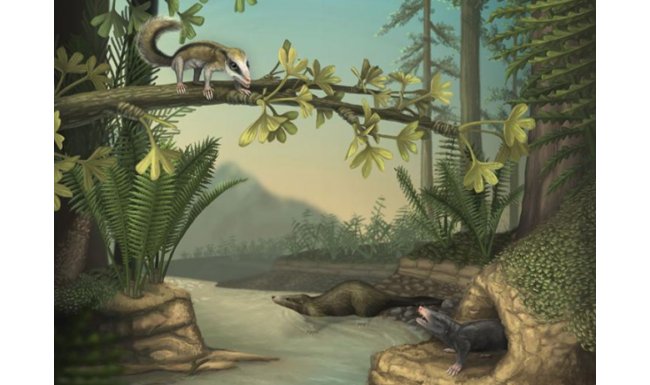
AsianScientist (Aug. 27, 2011) – Scientists have discovered a well-preserved fossil of the earliest known placental mammal.
The Juramaia sinensis fossil, or “Jurassic mother from China,” was found in northeast China’s Liaoning Province in 2009 and is approximately 160 million years old, according to a statement issued on Thursday by the Chinese Academy of Geological Sciences.
The discovery, made by a team of Chinese and American scientists from the Carnegie Museum of Natural History; Institute of Geology, Chinese Academy of Geological Sciences; and the Beijing Museum of Natural History, was published in the journal Nature on Thursday this week.
The discovery of a fossil on the placental side of the split shows that mammals diverged 35 million years earlier than previously believed, at around 160 million years ago, deep into the Jurassic period.
The age of the fossils also suggests a higher rate of evolution than previously thought, and fills an important gap in fossil records for the point of placental–marsupial divergence, the statement said.
Juramaia sinensis was an insectivorous mammal and is estimated to have had a body mass of 13 grams. The fossil is composed of an incomplete skull, part of its skeleton, and showed adaptations for climbing in trees.
The origin of placental mammals was an important event in mammalian evolutionary history, as almost all living mammals are placentals. A key event in mammalian evolution was the divergence between the ancestors of today’s placentals and those of the marsupials.
The article can be found at: Luo ZX et al. (2011) A Jurassic eutherian mammal and divergence of marsupials and placentals.
——
Source: Nature Publishing Group; Chinese Academy of Geological Sciences.
Disclaimer: This article does not necessarily reflect the views of AsianScientist or its staff.