AsianScientist (Jun. 17, 2011) – After Scott Rozelle and his colleagues at the Rural Education Action Project (REAP) found high rates of iron deficiency among China’s poorest children, the government began feeding some of them an egg every day.
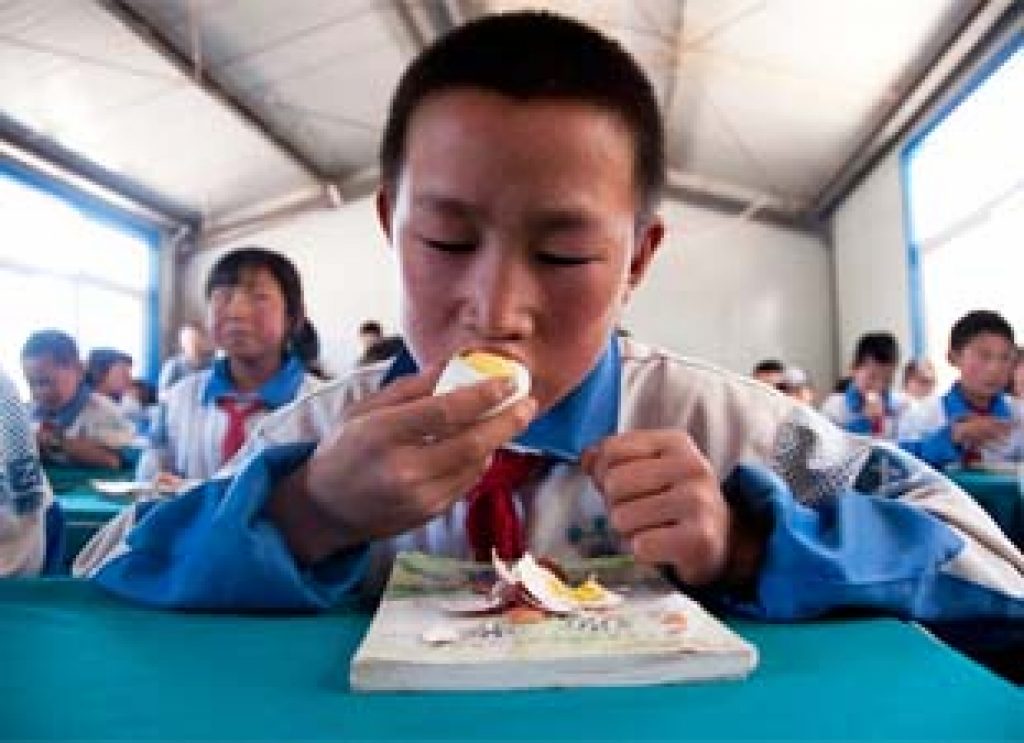
On schooldays, at about nine every morning, 11-year-old Dong Laifang and the 55 other fourth-graders at her school – the name of which translates to “Iron Dragon” – scoop a hardboiled egg out of a metal bucket placed at the front of their classroom.
But Rozelle is trying to convince the country’s officials that giving kids vitamins instead of eggs is a better way to fix the problem.
Eggs aren’t the answer
Nearly 40 percent of kids in this area have the iron deficiency, which often leads to lethargy and developmental problems that can impede their school performance and hurt their chances of leaving this desolate area for well-paying jobs in the city.
But eggs don’t even contain enough iron. They also take a long time to prepare. Laifang’s teacher, Bao Zhiyou, starts washing the eggs at 6:30 a.m., then boils the water for them. The process is still under way when his students arrive just before 8 a.m. After the eggs cook and cool, he brings them to his classroom by 9 a.m.
After REAP conducted research in 2008 that showed giving vitamins to fourth-graders in neighboring Shaanxi Province lowered anemia rates by about 35 percent and pushed test scores up from the equivalent of a C-plus to a B, officials there mandated that every kid would get an egg a day.
“We give the kids vitamins and get great results. Then, for whatever reason, the government gets this fixation with passing out eggs,” Rozelle says.
“They can procure them locally and eggs don’t go bad easily. But we’ve had no idea if giving a kid an egg has any impact.”
That led to the need for more experiments.
Vitamins, education, or money?
Because every child in Shaanxi started eating an egg a day, Rozelle looked next door at Gansu, where he tested the effects of giving students either an egg or a vitamin.
Early results from two tests involving about 1,600 children show the eggs did nothing to lower anemia rates in Gansu. Enough data hasn’t been analyzed to tell whether the eggs had any impact on grades.
But in villages where kids received a chewable vitamin every day, anemia usually went down by as much as 45 percent. Rozelle is hopeful that those results will prompt the government to give at-risk children vitamins. It’s a cheap fix – about three cents a day – to a problem that could have big societal costs.
“Part of the issue is that the government thinks nutrition is something that should be dealt with at home,” Rozelle says about China’s reluctance to incorporate vitamins into a daily regimen at school.
Another hang-up could be that principals and teachers are reluctant to pass out pills they think are medicine.
So in another round of experiments in a province to the northeast, REAP is designing a package of financial incentives to motivate school officials.
The researchers are also studying what effect parent and teacher training may have, although other REAP studies show that informational sessions on nutrition and anemia haven’t made a dent in the problem.
Rozelle has also struck a deal with Madhouse, a mobile advertising company based in Shanghai. The company agreed to send 200,000 text messages, aimed at increasing anemia awareness, to the cell phones of 8,000 randomly selected parents during the upcoming academic year. REAP researchers will then compare the anemia rates of children before and after the texting begins.
——
Source: Stanford Rural Education Action Project.
Disclaimer: This article does not necessarily reflect the views of AsianScientist or its staff.