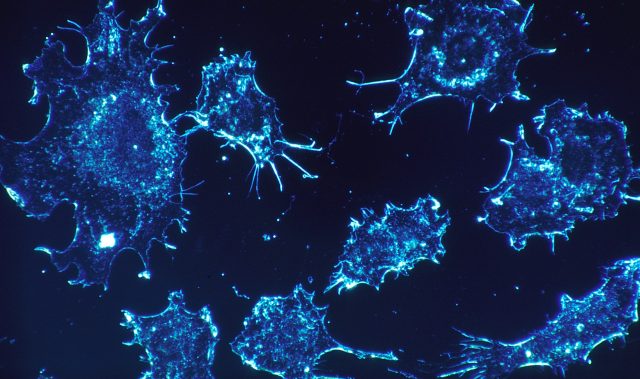
AsianScientist (June 6, 2011) – In a world’s first, medical scientists in Australia have used an ultra powerful microscope to discover how T-cells, the front-line troops of the immune system, are activated.
Published this week in the journal Nature Immunology, researchers led by Associate Professor Katharina Gaus from University of New South Wales (UNSW) used Australia’s only microscope capable of super-resolution fluorescence microscopy to reveal the immunity ‘switch’ in T-cells.
Powerful microscopes of yesteryear allowed scientists to see T-cells under a microscope, but not what their individual molecules were doing. This led to flawed theories of T-cell activation.
“Previously it was thought that T-cell signalling was initiated at the cell surface in molecular clusters that formed around the activated receptor,” said Gaus.
“In fact, what happens is that small membrane-enclosed sacks called vesicles inside the cell travel to the receptor, pick up the signal and then leave again,” she said.
Gaus said the discovery explained how the immune response could occur so quickly.
“There is this rolling amplification. The signalling station is like a docking port or an airport with vesicles like planes landing and taking off. The process allows a few receptors to activate a cell and then trigger the entire immune response,” she said.
Ph.D. candidate David Williamson, whose research formed the basis of the paper, said the discovery showed what could be achieved with the new generation of super-resolution fluorescence microscopes.
“In conventional microscopy, all the target molecules are lit up at once and individual molecules become lost amongst their neighbors – it’s like trying to follow a conversation in a crowd where everyone is talking at once,” he said.
“With our microscope we can make the target molecules light up one at a time and precisely determine their location while their neighbors remain dark. This ‘role call’ of all the target molecules means we can then build a ‘super resolution’ image of the sample,” he said.
The article can be found at: Gaus K et al. (2011) Pre-existing clusters of the adaptor Lat do not participate in early T cell signaling events.
——
Source: University of New South Wales.
Disclaimer: This article does not necessarily reflect the views of AsianScientist or its staff.