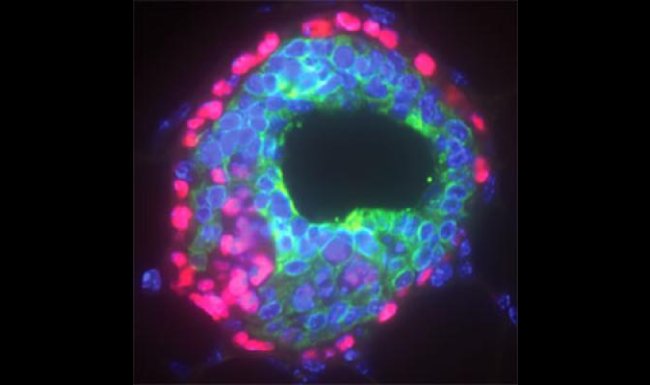
AsianScientist (Jun. 19, 2013) – Scientists are now able to markedly improve drug targeting of solid tumors using tiny ‘biosensors’ along with new advanced imaging techniques.
In a study published in Cancer Research, researchers demonstrated the use of these technologies for tracking the anti-tumor effect of a drug, known as dasatinib, which is currently in phase II clinical trials for the treatment of pancreatic cancer.
According to the researchers, these new technologies can show how cancers spread and how active cancer cells respond to a particular drug. These events can now be visualized in real time and in three dimensions.
“Until now, we have been limited to studying tumor signalling in two dimensions – and lacked a dynamic way of reporting on drug targeting in live tumor tissue,” said Dr Paul Timpson of the Garvan Institute of Medical Research in Australia who is a co-author of the study.
“Nanotechnology opens up a portal into living tissue that allows us to watch cancers spreading, and to determine which parts of a tumor we should be targeting with drugs.”
“This imaging technology has allowed us to map areas within the tumor that are highly aggressive, allowing us to pinpoint regions of poor drug delivery deep within a tumor at sub-cellular resolution. We can then see where we need to improve on drug delivery to improve clinical outcome.”
The technology can also be used to guide the use of ‘combination therapies’ that enhance drug delivery by breaking up the tissue surrounding a tumor. Such therapies may be particularly effective in treating pancreatic tumors because they are extremely dense with collagen and have poor blood vessel networks for delivering drugs.
“The trick is to break down the structure just enough to get the drug in, but not so much that you damage the organ itself,” said Prof Kurt Anderson, a member of the research team.
“These new technologies help us gauge what is just enough and not too much.”
The article can be found at: Nobis et al. (2013) Intravital FLIM-FRET Imaging Reveals Dasatinib-Induced Spatial Control Of Src In Pancreatic Cancer.
——
Source: Garvan Institute of Medical Research.
Disclaimer: This article does not necessarily reflect the views of AsianScientist or its staff.