AsianScientist (Sep. 23, 2016) – While the last thing you may have fished for was compliments, fishing itself has been practiced for tens of thousands of years. Archaeologists in Japan have recently uncovered the world’s oldest fishhooks in a limestone cave, where the world’s oldest known anglers lived nearly 30,000 years ago.
Details of the fishhooks, estimated to be nearly 23,000 years old, were published in Proceedings of the National Academy of Sciences.
Modern humans expanded into living on oceanic islands 50,000 years ago, but the developmental process of maritime technology at the time remains unclear, hampered by incomplete archaeological records. The discovery suggests a geographically wider distribution of early, advanced maritime technology in that era than previously thought.
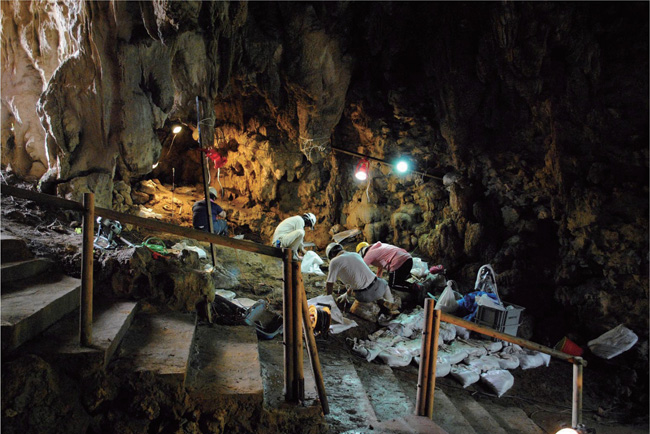
Researchers from several institutes in Japan, including the Okinawa Prefectural Museum & Art Museum and the University of Tokyo, made the discovery of the fishhooks and other fishing paraphernalia in Sakitari Cave on Okinawa island, indicating successive human occupation extending back 35,000-30,000 years. The fishhooks were carved from sea snail shells.
The fish hooks predate ones found in Timor, thought to be at least 16,000 years old, and Papua New Guinea, from at least 18,000 years ago.
“On the oceanic island of Okinawa, we unearthed evidence of the unique lifestyle of the Paleolithic people. They created a variety of shell artifacts, including the world’s oldest fishhooks, beads, and several types of scrapers,” corresponding author Dr. Masaki Fujita told Asian Scientist Magazine.
“They also returned to the cave seasonally, capturing freshwater crabs during autumn when they are most delicious.”
According to Fujita, freshwater snails, eels, and marine fish were also consumed at the site, but terrestrial animals such as wild boar were rare. This unique lifestyle enabled them to live on the relatively resource-poor island for more than 20,000 years.
“We also found fish bones from the 30,000-35,000-year-old layers, along with human bones and other aquatic animal remains. In the future, we hope to find some fishing tools from these older layers,” said Fujita.
.jpg)
The article can be found at: Fujita et al. (2016) Advanced Maritime Adaptation in the Western Pacific Coastal Region Extends Back to 35,000–30,000 Years before Present.
———
Copyright: Asian Scientist Magazine; Photo: Masaki Fujita.
Disclaimer: This article does not necessarily reflect the views of AsianScientist or its staff.