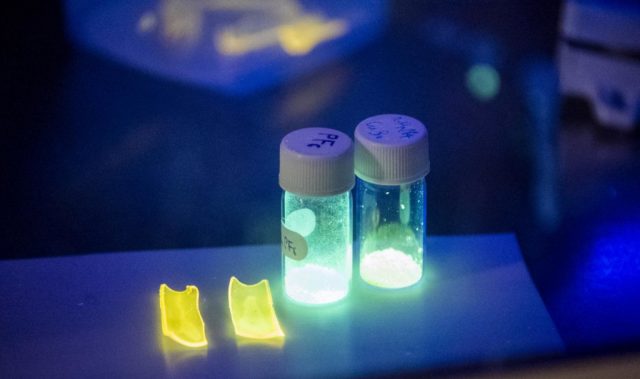
AsianScientist (May 11, 2017) – In a study published in Advanced Materials, researchers describe a new kind of sensor molecule that can light up when placed under heavy mechanical stress. Unlike other such photoluminescent mechanophores, the new material retains it’s stress-sensing ability over repeated exposures.
Currently available photoluminescent mechanophores typically involve a strong force—compressing, twisting or stretching for example—to break a specific chemical bond between two atoms or irreversibly pull apart two molecular patterns in the sensing molecule. The force changes the wavelength—and thus the color—of the light emitted by the mechanophore.
Once these molecules have radically changed their structure in response to this force, it is extremely difficult to return to the initial state. While these mechanophores are useful to understand the mechanical properties of an item or a material, they do not suit well for repeated exposure to mechanical stress.
To overcome this issue, Dr. Georgy Filonenko and Professor Julia Khusnutdinova from the Coordination Chemistry and Catalysis Unit at the Okinawa Institute of Science and Technology (OIST) incorporated a stress-sensing molecule into a common polymer material called polyurethane, widely used for everyday items from mattresses and cushions to inflatable boats, car interiors, woodworking glue and even spandex.
The scientists then stretched the resulting material with increasing force, triggering a correspondingly brighter glow under an ultraviolet light. The reaction happened within hundreds of milliseconds, resulting in a up to two-fold increase in luminescence intensity. When the mechanical traction stops, the polymer material and the mechanophore reverse to their initial position, decreasing the light readout. This is critical as it allows for repeated applications of mechanical force.
The high mobility of the mechanophore molecules in the polymer was found to be the key to the sensor performance. As mechanophores moved rapidly in the relaxed polymer sample, the brightness of emission was low due to these molecular motions preventing the mechanophore from emitting light. However, subjecting the material to mechanical force effectively slowed down the polymer chain motions, enabling the mechanophore to emit light more efficiently.
“Our material shows how a macroscopic force, as basic as stretching a flexible strand of material, can efficiently trigger microscopic changes all the way down to isolated molecules,” said Filonenko.
The article can be found at: Filonenko & Khusnutdinova (2017) Dynamic Phosphorescent Probe for Facile and Reversible Stress Sensing.
———
Source: Okinawa Institute of Science and Technology Graduate University; Photo: Michelaine/Flickr/CC.
Disclaimer: This article does not necessarily reflect the views of AsianScientist or its staff.