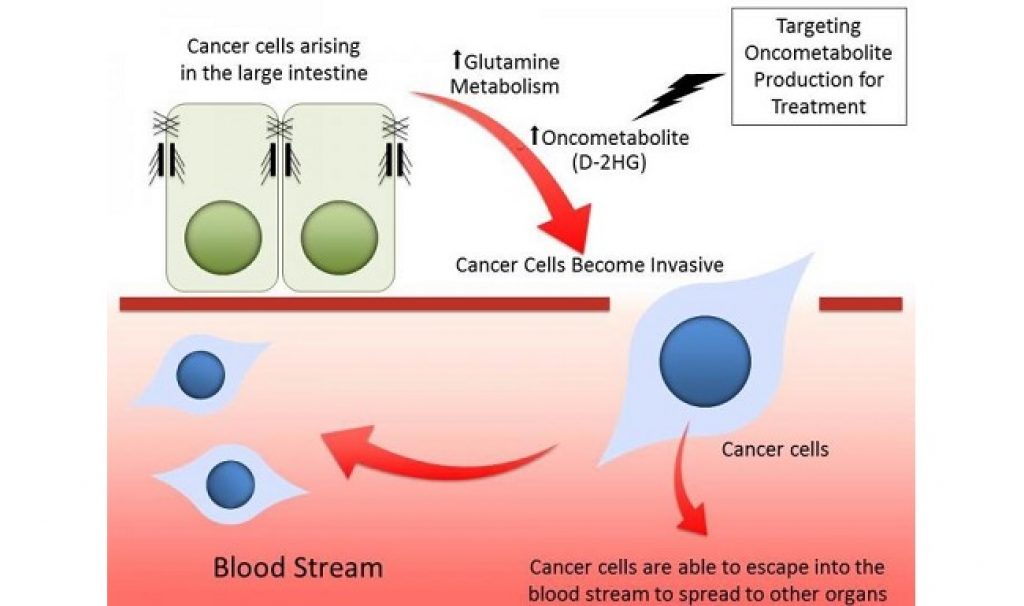
AsianScientist (Dec. 8, 2016) – Researchers in Japan have identified a metabolite that causes cancer cells to develop more dangerous properties and increases the likelihood that cancer will spread in colorectal cancer patients. Their work was published in Scientific Reports.
Cancer cells exhibit a range of properties that diverge from those of their normal healthy counterparts, including levels of various metabolites. However, it has been difficult to determine whether such altered levels is a cause or a consequence of the cancerous growth.
The Osaka University team examined different varieties of cancer cells and cells from normal tissues and revealed high levels of a metabolite called D-2-hydroxyglutarate (D-2HG) in colorectal cancer cells. They then administered D-2HG into cancer cells and found that it caused the cells to undergo transformation. This transformation involved the cells adhering less strongly to each other and migrating more easily—properties which are associated with cancer progression and spread.
“When we grew the cells with D-2HG on plates and measured their movement, they migrated further than untreated cells,” noted lead author Dr. Hugh Colvin.
The researchers showed that D-2HG acts by increasing the expression of a gene called ZEB1, which promotes this cell transformation. They also obtained specimens from 28 human colorectal cancer patients and divided them into two groups with low or high levels of D-2HG. The patients’ records showed that the high group had more often suffered cancer spread to distant organs, which suggested the importance of D-2HG in patient prognosis.
“When cancer cells initially emerge, it can be difficult for them to survive and multiply because of the local conditions,” said coauthor Dr. Hideshi Ishii. “D-2HG makes cancer cell survival more likely by causing them to transform from epithelial to mesenchymal cells, meaning that they can invade local tissue, enter the blood, and be transported elsewhere to establish a new tumor.”
With the importance of this molecule in cancer progression and prognosis revealed, it can be focused on as a promising target for colorectal cancer treatments.
The article can be found at: Colvin et al. (2016) Oncometabolite D-2-Hydroxyglurate Directly Induces Epithelial-Mesenchymal Transition and is Associated with Distant Metastasis in Colorectal Cancer.
———
Source: Osaka University.
Disclaimer: This article does not necessarily reflect the views of AsianScientist or its staff.