AsianScientist (Nov. 1, 2016) – Paleontologists from China and Sweden have traced the evolution of modern human jaws back to the extinct placoderms, armored prehistoric fish that lived over 400 million years ago. The article was published in Science.
Jaws first appear in the developing embryo as a cartilage bar similar to a gill arch. In a shark, this develops directly into the adult jaws, but in an embryo of a bony fish or a human being new bones appear on the outside of the cartilage. In our own skull, these bones—the dentary, maxilla and premaxilla—make up the entire jaws and carry our teeth.
It is universally accepted that the dentary, maxilla and premaxilla are a shared heritage of bony fishes and tetrapods: you will find these same bones in a crocodile or a cod. But going further back in time, only one other group of fishes, the extinct placoderms, have a similar set of jaw bones. However, these bones, known as ‘gnathal plates,’ have always been regarded as unrelated to the dentary, maxilla and premaxilla.
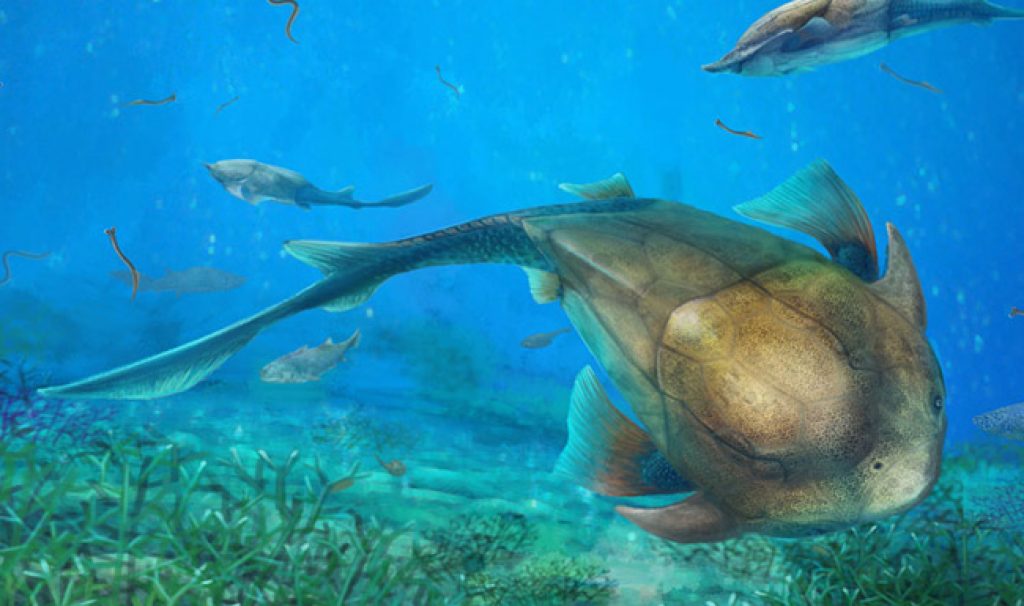
The picture began to change fundamentally in 2013 with the description of Entelognathus, a 423 million-year-old Silurian fossil fish from Yunnan in China which combines a classic placoderm skeleton with presence of a dentary, maxilla and premaxilla. Together with the discovery of placoderm-like characteristics in some of the earliest bony fishes, this began to build a strong case for a close relationship between placoderms and bony fishes, accompanied by a substantial carry-over of placoderm characteristics into bony fishes (and hence ultimately to us). But what about those jaws? Where did they come from?
This is where the new fossil, Qilinyu, comes in. In the present study by palaeontologists from the Institute of Vertebrate Paleontology and Paleoanthropology in Beijing and Uppsala University in Sweden, Qilinyu is described as coming from the same place and time period as Entelognathus, and also combines a placoderm skeleton with dentary, maxilla and premaxilla. This, despite the fact that the two fishes otherwise look quite different and must have had different lifestyles.
Looking at the jaw bones of Entelognathus and Qilinyu it is apparent that in both fishes, they combine characters of the bony fish jaw bones and placoderm gnathal plates. The simplest interpretation of the observed pattern is that modern humans’ jaw bones are the old gnathal plates of placoderms but lightly remodeled, according to the authors.
It seems like substantial parts of modern human anatomy can be traced back, not only to the earliest bony fishes, but beyond them to the strange ungainly armored placoderms of the Silurian period.
The article can be found at: Zhu et al. (2016) A Silurian Maxillate Placoderm Illuminates Jaw Evolution.
———
Source: Uppsala University.
Disclaimer: This article does not necessarily reflect the views of AsianScientist or its staff.