AsianScientist (Sep. 13, 2016) – Researchers in Japan have developed a versatile method to form nanowires based on amyloid peptides, the causative molecule for Alzheimer’s disease. Details of their technique were published in Scientific Reports.
There has been considerable interest worldwide in the patterning of functionalized nanowires for their excellent applications such as semiconductors and catalyzers. Previously, the research team led by Professor Kazuyasu Sakaguchi from Hokkaido University had developed an effective method to control the self-assembly of amyloid peptides, which they called structure-controllable amyloid peptides (SCAPs).
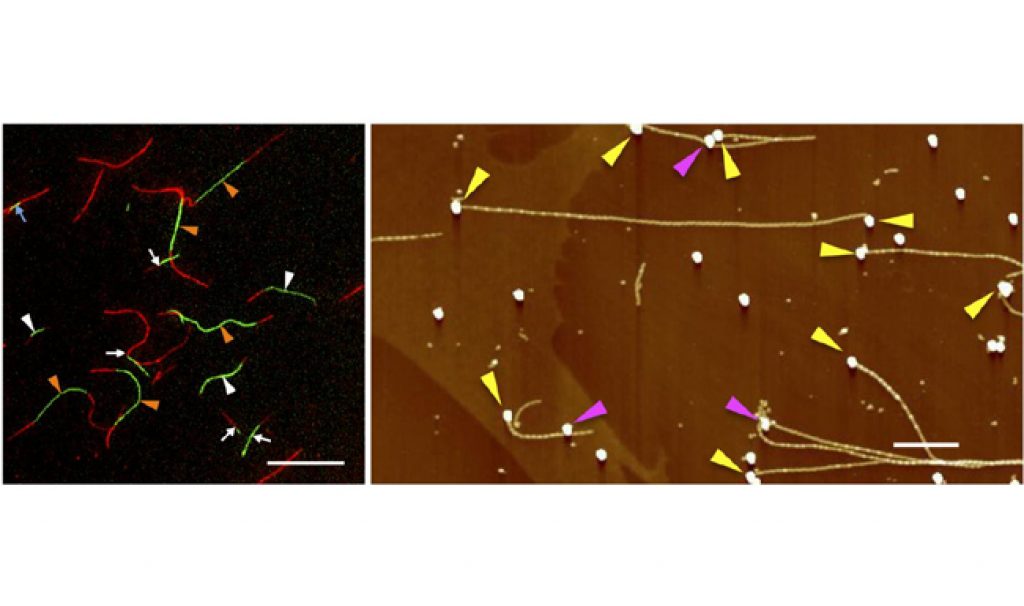
Following the SCAP method, the researchers used green fluorescence-labeled amyloid fibrils as a template to allow another type of amyloid peptide, marked by red fluorescence, to extend from the starting fibrils. To achieve pattern control, they attached the template fibrils to gold nanoparticles placed on the substrate surface.
Besides being applicable to the self-assembly of nanowires for nanoelectrodes created by lithography, this method could also be used to prepare a wide variety of fibril patterns and hence open up new avenues for the development of novel self-assembled nanodevices, Sakaguchi said.
The article can be found at: Sakai et al. (2016) Patterning Nanofibrils through the Templated Growth of Multiple Modified Amyloid Peptides.
———
Source: Hokkaido University.
Disclaimer: This article does not necessarily reflect the views of AsianScientist or its staff.