AsianScientist (Aug. 16, 2016) – A study from Japan has revealed a mechanism controlling the orientation of cell division in epithelial cells, which are the cells that form the lining or covering of a body surface. The work was published in eLife.
Cell division is a fundamental process of life, producing two cells from one single cell at each division. How many times a cell undergoes cell division and how the two daughter cells are positioned after the division can be critical for shaping an organism.
Although the machinery essential for cell division is well-characterized and evolutionarily conserved, how a cell division is oriented relative to the animal’s body axis remains unknown in most animals.
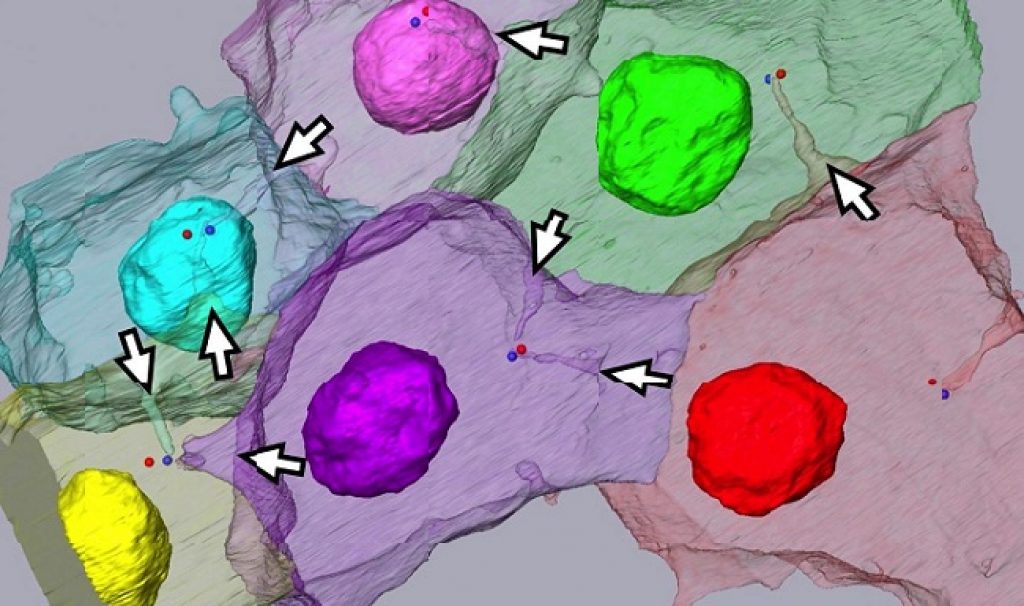
Researchers from the National Institutes of Natural Sciences have found that in a sea squirt (Ciona intestinalis) embryo, the orientation of the cell division machinery in epithelial cells is controlled by a unique cell membrane structure called invagination. Invagination is the in-folding of the outer layer of cells so as to form a ‘pocket’ in the surface.
Dr. Takefumi Negishi of the National Institutes of Natural Sciences, the first author of the study said, “When I observed this structure dynamically moving and extending within the cell, I immediately thought this might be playing an essential role for cellular function.”
Live imaging by fluorescence microscopy revealed that the invaginations originated from the posterior or tail side of each epithelial cell and grows intracellularly toward the centrosome, an essential component of the cell division machinery. Using specialized electron microscopy, the authors demonstrated that the tip of invagination associates closely with the centrosome.
Based on these findings, the authors propose an entirely new model for controlling cell division orientation, which involves the membrane structure repositioning the cell division machinery to one end of the cell, thus orientating the subsequent cell division.
Professor Naoto Ueno of the Graduate University for Advanced Studies, who co-supervised the current study, said, “We hope our findings facilitates studies on similar membrane structures in other animals that might have diverse biological functions.”
The article can be found at: Negishi et al. (2016) Physical Association Between a Novel Plasma-membrane Structure and Centrosome Orients Cell Division.
———
Source: National Institutes of Natural Sciences.
Disclaimer: This article does not necessarily reflect the views of AsianScientist or its staff.