AsianScientist (May 30, 2016) – Researchers in Japan have shown that the resistivity of carbon nanocoils (CNCs) increases with coil diameter.
Their findings, published in Applied Physics letters, pave the way for CNC-based nanodevices, ranging from electromagnetic wave absorbers to nano-solenoids and extra-sensitive mechanical springs.
Carbon nanocoils (CNCs) are an exotic class of low-dimensional nanocarbons whose helical shape may make them suitable for applications such as microwave absorbers and various mechanical components, including springs.
Typical thicknesses and coil diameters of CNCs fall within the ranges of 100-400 nm and 400-1000 nm respectively, and their full lengths are much larger, on the order of several tens of micrometers. Despite earlier pioneering work, the relationships between the geometric shape of natural CNCs and their mechanical and electrical properties—particularly their electrical resistivity—are not well understood.
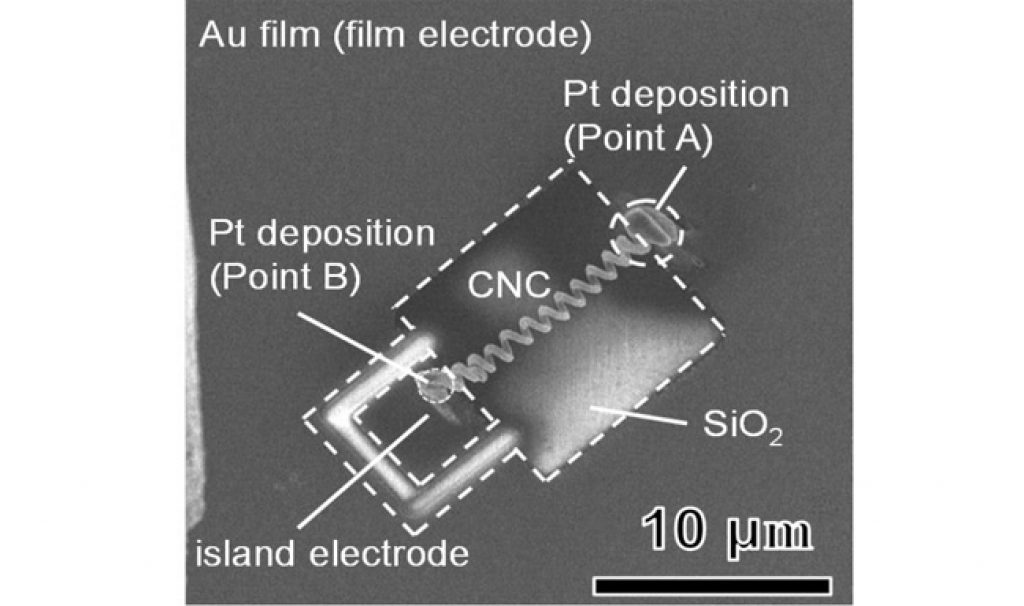
To determine that the resistivity of CNCs increases with coil diameter, the research team from Toyohashi University of Technology developed a precise resistivity measurement method. They used a focused ion beam and nanomanipulator technique to select a sample CNC with the desired coil geometry, and then made electrical connections to the instrument’s electrodes. All the resistivity data obtained with CNCs aligned with a curve predicted by a theory known as variable range-hopping (VRH), which is used for disordered materials at low temperatures.
The research shows that the interior of the nanocoil contains material that affects its electrical properties. The scientists examined 15 individual CNCs, and three CNCs that had been artificially-graphitized to give them lower resistivity (G-CNCs). Although the resistivity of the CNCs increased with coil diameter, it was almost unchanged for the G-CNCs. As a consequence, for the CNCs with the largest diameters, the resistivity was almost two orders of magnitude larger than that of the graphitized versions.
This large discrepancy in the resistivity between CNCs and G-CNCs indicates a significant structural complexity inside the CNCs. The reseach team’s results imply that the interior of CNCs with a large coil diameter is filled with a highly-disordered carbon network that consists of many small regions, known as sp2 domains, embedded in a sea of amorphous carbon.
To verify this theory, they examined temperature dependence of the resistivity between 4 K and 280 K. The resistivity data obeyed two different versions of the VRH theory, and interestingly, the resistivity curves shifted smoothly between regimes as the coil diameter was changed.
“We found this behavior three years ago. Owing to the efforts of two students, we included the resistivity data for G-CNCs and straight carbon nanofibers, and compared them to the data for the CNCs,” explained Associate Professor Yoshiyuki Suda, who led the study.
“We obtained the low-temperature measurement data and discussed it using the VRH theory. Eventually, we came to the conclusion that this behavior is a unique phenomenon for CNCs and can be fitted by VRH.”
The article can be found at: Nakamura et al. (2016) Precise Measurement of Single Carbon Nanocoils Using Focused Ion Beam Technique.
———
Source: Toyohashi University of Technology.
Disclaimer: This article does not necessarily reflect the views of AsianScientist or its staff.