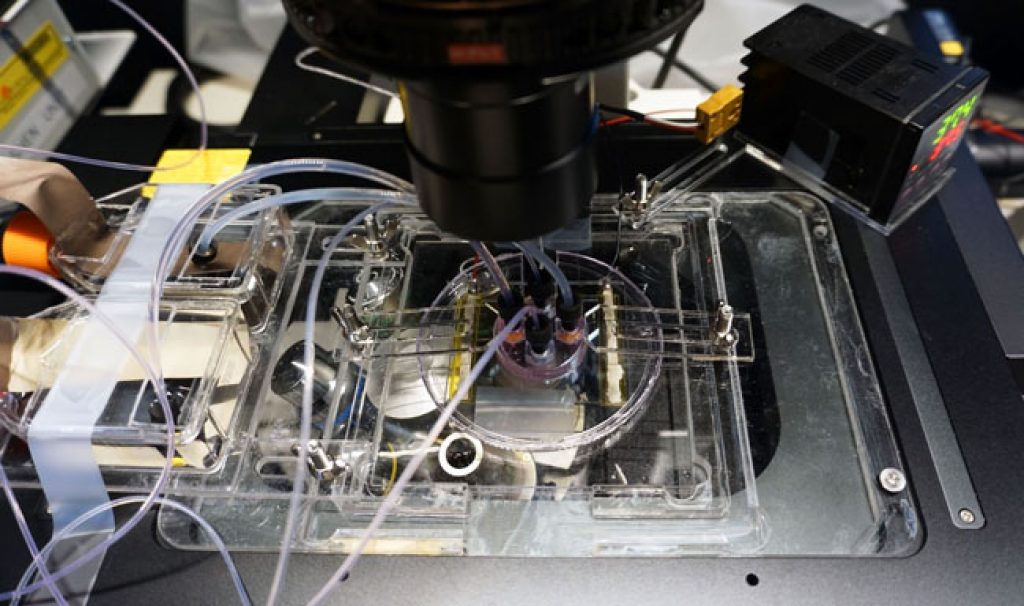
AsianScientist (May 26, 2016) – Researchers in Japan have come up with a way to solve a common problem: rectangular electric fields in round laboratory cultureware. They have created a plastic insert that modifies the pathways of the electric current in a circular shape. Details of their device have been published in Scientific Reports.
Electricity plays a key role in cell studies, but there are practical issues owing to the shape of the laboratory cultureware, plastic containers used by researchers to grow cells. While cultureware like a petri dish is circular, the simplest way to create a uniform electric field is based on a rectangular shape. These different geometries prevent scientists from fully exploiting the potential of a cell cultureware, as a substantial part of the round petri dish base remains outside of the field-generating rectangle that goes into the cultureware.
PhD student Mr. Tsai Hsieh-Fu, under the supervision of Professor Amy Shen, head of the Micro/Bio/Nanofluidics Unit at the Okinawa Institute of Science and Technology Graduate University (OIST), sought to address this problem. His research project focused on cell behavior in an electric field.
“Cells respond to electric current,” Tsai explained. “Some cells migrate towards the positive pole, while others towards the negative pole, and some cells show a specific alignment with the electric field.”
These phenomena are known to play an important role in key biomedical areas, like wound healing and the early stages of cell development, such as neurogenesis and embryogenesis.
Scientists typically choose to study cells in a uniform electric field, as such an even field is the simplest case to work with in a controlled setting. An effective way to create a uniform electrical field is through a rectangular device, because the electric poles are connected to two of the opposite sides of the rectangle, and thus the pathways of the electric current are all of the same length.
However, as most standard cell cultures happen in a circular shaped environment, like a petri dish, it is not possible to directly create a uniform electric field just connecting electric poles to the opposite sides of a circle.
“The walls of a petri dish are curved,” Shen commented, “and in a circle the pathways of the electric current are of different lengths, so the resulting electric field is not uniform.”
Thus, Tsai and colleagues created a simple and inexpensive insert that achieves uniformity within the field by making the shorter pathways run inside the device itself, and thus extending their length until they match the longer pathways.
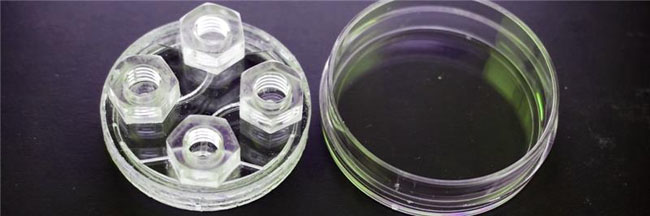
The design of the insert is based on the fundamental principles of electricity, which helped the researchers in finding the optimal shape of the device. Once the shape is defined, the insert can be directly created with a 3D printer. Thanks to this simple process, the insert is scalable and can be easily adapted to fit most of the common laboratory cultureware of any size. To date, OIST scientists have already tested the performance of the device during a successful experiment on mouse embryonic fibroblast cells.
“One of the advantages is that, with this device, researchers can use most of the surface coverage of the dish,” Shen said. “This results in higher cell count, and thus in more samples for further experiments.”
The article can be found at: Tsai et al.(2016) Uniform Electric Field Generation in Circular Multi-well Culture Plates using Polymeric Inserts.
———
Source: Okinawa Institute of Science and Technology Graduate University.
Disclaimer: This article does not necessarily reflect the views of AsianScientist or its staff.