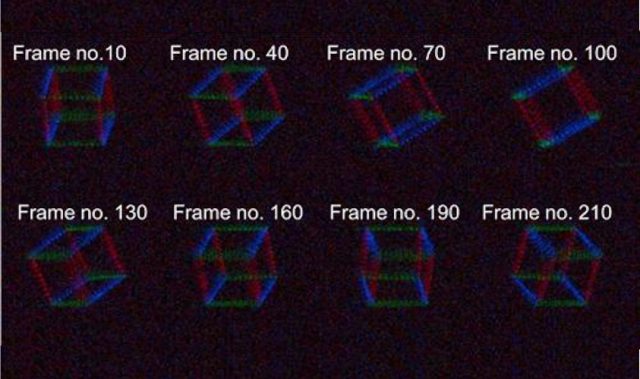
AsianScientist (Apr. 26, 2016) – Researchers in Japan have developed a holographic display that could do away with 3D glasses altogether for a more comfortable movie viewing experience. Their work was published in Applied Physics Letters.
Conventional 3D displays show 2D images for each eye, leaving the brain the resolve the two images. These pseudo 3D images can cause incongruity and eye strain in certain users. On the other hand, a holographic display produces an exact copy of the wave front of scattered light from an object, hence forming a realistic 3D display and eliminating the need for 3D glasses.
However, construction of holographic displays is difficult, as nano-sized pixels are required for reconstructing 3D images with a wide viewing angle. Conventional holographic displays have a viewing angle of less than 3° and a pixel pitch of 10-100 µm.
The researchers, led by Associate Professor Hiroyuki Takagi from the Toyohashi Institute of Technology, have recently developed wide-viewing 3D holographic displays composed of nano-magnetic pixels. These displays use magneto-optic spatial light modulators (MOSLMs) to achieve nano-sized pixels and wide viewing angles.
“The advantages of this approach are that the focused spot of a laser defines the pixel size; the MOSLM does not require special current or voltage drivelines; and the switching speed is about 10 nsec/pixel that is enough for real-time display,” said Takagi.
“Therefore, the MOSLM can represent 3D movies, because display media is a rewritable magnetic material. In addition, the magnetic hologram is stored for magnetic materials semi-permanently. The viewing angle depends on pixel pitch size. In this study, we adjusted to the pixel pitch size of 1 μm after obtaining the pixel size of 1 µm.”
These findings confirm that a 3D display with 1-µm-pitch pixels can display holographic images at viewing angles of over 30°. Therefore, this display could be a glassless way to view 3D objects with smooth motion, the researchers say.
The article can be found at: Nakamura et al. (2016) Improvement of Diffraction Efficiency of Three-Dimensional Magneto-Optic Spatial Light Modulator with Magnetophotonic Crystal.
———
Source: Toyohashi Institute of Technology; Photo: Oona Räisänen/Flickr/CC.
Disclaimer: This article does not necessarily reflect the views of AsianScientist or its staff.