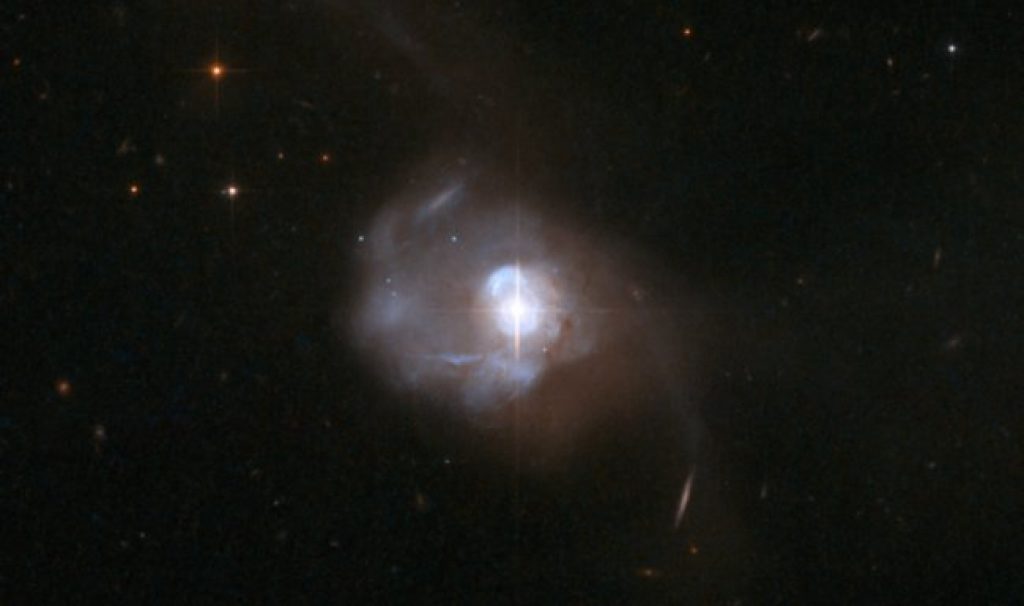
AsianScientist (Sep. 15, 2015) – Lu Youjun and Yan Changshuo at National Astronomical Observatories of Chinese Academy of Sciences have found a supermassive binary black hole hiding at the center of Markarian (Mrk) 231, the nearest galaxy to Earth that hosts a quasar. This work was published in the Astrophysical Journal.
Search for binary black holes is of great importance not only for deep understanding of the formation and evolution of galaxies but also for further investigating the gravitational wave radiation and testing the gravity theory. Observations show that most galaxies, if not all, host supermassive black holes in their centers.
In the standard galaxy formation model, a big galaxy is assembled through merger and collision of two small galaxies. The two central supermassive black holes fall into orbit about one to another as a result of the merger and generate tremendous amount of gravitational wave radiation at the end of the orbiting.
In the mean time, the merger can cause the gas in the two small galaxies, if gas rich, sinking into the center of the merged galaxy and triggers a brilliant quasar there. Astrophysicists expect the existence of binary black holes in many of those brilliant quasars. However, the evidence is still ambiguous and uncertain.
Researchers from National Astronomical Observatories of Chinese Academy of Sciences, University of Oklahoma, and Kavli Institute for Astronomy and Astrophysics-Peking University, investigated the optical-ultraviolet continuum spectrum from the core of Mrk 231. They found that the “surprising and extreme feature”, a deficit, in the optical to ultraviolet continuum of Mrk 231, is best explained by a model involved a supermassive binary black hole.
If only one black hole were present in the center of the quasar, the whole accretion disk made of surrounding hot gas would glow in ultraviolet rays. Instead, the ultraviolet glow of the gaseous disk abruptly drops off toward the center. This provides observational evidence that the disk has a big donut hole encircling the central black hole.
The best explanation for the observational data, based on dynamical models, is that the center of the disk is carved out by the action of two black holes orbiting each other. The central black hole is estimated to be 150 million times the mass of our sun, and the companion weighs in at four million solar masses.
The second, smaller black hole orbits in the inner edge of the accretion disk, and has its own mini-disk with an ultraviolet glow. The dynamic duo completes an orbit around each other every 1.2 years. The binary black holes are predicted to spiral together and collide within a few hundred thousand years.
“This finding shows the existence of a close binary black hole in Mrk 231, but also paves a new way to systematically search binary black holes via the nature of their ultraviolet light emission,” said Lu.
“The structure of our universe, such as those giant galaxies and clusters of galaxies, grows by merging smaller systems into larger ones, and binary black holes are natural consequences of these mergers of galaxies,” added co-investigator Dai Xinyu of the University of Oklahoma.
The lower-mass black hole is the remnant of a smaller galaxy that merged with Mrk 231, located only about 600 million light-years away from the earth. Evidence of a recent merger comes from the host galaxy’s asymmetry, and the long tidal tails of young blue stars.
The result of the merger has been to make Mrk 231 an energetic starburst galaxy with a star formation rate 100 times greater than that of our Milky Way galaxy. The infalling gas fuels the black holes’ “engine”, triggering outflows and gas turbulence that incites a firestorm of star birth.
The article can be found at: Yan et al. (2015) A Probable Milliparsec Supermassive Binary Black Hole in the Nearest Quasar Mrk 231.
———
Source: Chinese Academy of Sciences; Photo: NASA.
Disclaimer: This article does not necessarily reflect the views of AsianScientist or its staff.