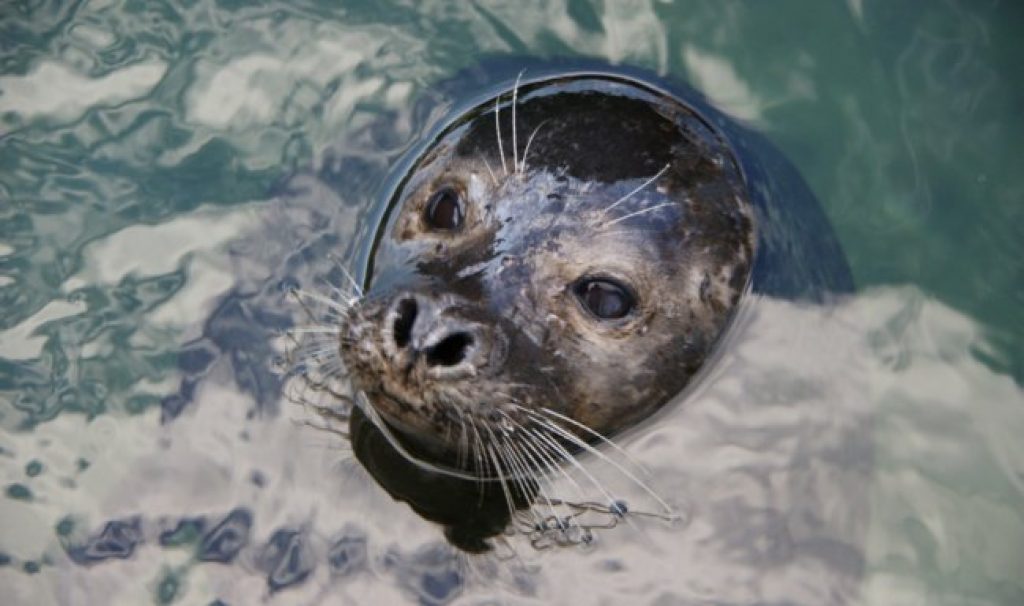
AsianScientist (Aug. 20, 2015) – Inspired by seals, which can use their whiskers to sense fish hundreds of meters away, researchers at the University of Illinois at Urbana-Champaign and the Advanced Digital Sciences Center (ADSC) in Singapore have developed artificial whiskers that could give doctors a ‘sixth sense’ during surgery. Their work was published in the journal Bioinspiration & Biomimetics.
The robo-whiskers could be especially useful during laparoscopy, or keyhole surgery, a minimally invasive procedure in which the surgeon guides a thin instrument through a tiny incision in the body.
“Animals like seals spend a good deal of time in dark and murky environments where they can’t rely on their vision system to see,” said Dr. Cagdas Tuna, a postdoctoral researcher at ADSC, a University of Illinois research center in Singapore.
“But they are able to use their whiskers to sense their environments. We’re hoping to give surgeons a similar tool when performing these delicate procedures where visibility is low.”
While laparoscopy can benefit patients with faster recovery times and fewer complications, it can be more challenging for surgeons, who don’t have direct access to the operation site during this type of procedure. A surgical catheter with whiskers could offer tactile feedback similar to the nerve endings in our hands.
Tuna began examining the potential of robo-whiskers as an electrical and computer engineering graduate student in advisor Professor Douglas Jones’ signal processing lab in 2010. After reading about seals’ ability to use their whiskers as sensing instruments, the team began to consider how to replicate the ability artificially—a field called biomimetics.
Tuna tackled the problem by exploiting the whisker structure and turning it into a well-known imaging problem. Using a novel tomographic, tactile fluid-flow imaging technique—similar to how a CT scan works—researchers were able to use an artificial whisker array to reconstruct the surroundings. They tested out the array using a hotwire anemometer and demonstrated that they were able to generate very accurate tomographic images of the localized fluid-flow sources.
The researchers’ first prototype, built with discount-store items such as Legos and drinking straws, is rudimentary to say the least, Tuna says. Before it could be used in surgery, the technology would need to integrate object contact capability in the current whisker-based robotic system.
In the future, the research could also provide guidance for submarines, drones and other systems where navigation and tracking in low-visibility environments is critically important.
“We’re going to continue working on a more generalized image model and focus on even better tracking and navigation,” Tuna said.
The article can be found at: Tuna et al. (2015) Tactile Soft-Sparse Mean Fluid-Flow Imaging with a Robotic Whisker Array.
———
Source: Advanced Digital Sciences Center; Photo: Martin Abegglen/Flickr/CC.
Disclaimer: This article does not necessarily reflect the views of AsianScientist or its staff.