AsianScientist (Jun. 25, 2015) – Using microfluidics, researchers have used amyloid fibrils normally associated with diseases such as Alzheimer’s to generate enzymatically active microgels. Their results have been published in ACS Nano.
Amyloid fibrils are highly ordered protein or peptide fibrillar aggregates associated with both neurodegenerative diseases and functional use in nature. The extraordinary stability and tunable self-assembly of amyloid fibrils have been motivated as potential nanomaterials.
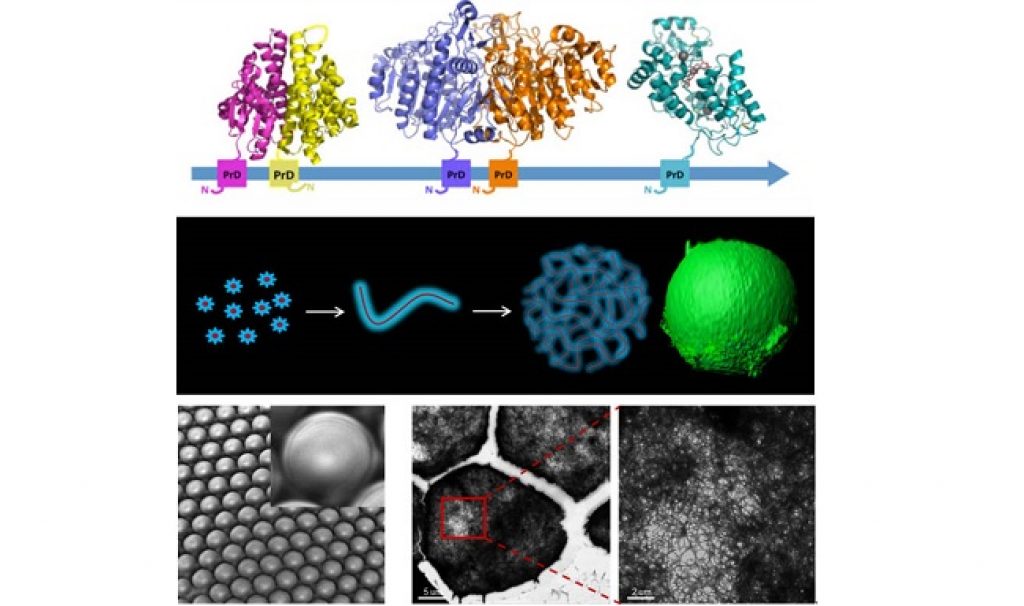
In the present study, Professor Sarah Perrett at the Institute of Biophysics (IBP) of the Chinese Academy of Sciences and Professor Tuomas Knowles’ group in the Chemistry Department at the University of Cambridge, synthesized enzymatically active microgels that are stabilized by amyloid nanofibrils.
A microgel is a three-dimensional colloidal network of micron-scale size and has biomedical applications, such as drug delivery and microsensor biomaterials. To date, most microgels have been generated using synthetic molecules, with the polymerization reaction requiring non-biocompatible conditions or reagents, such as extreme pH, temperature, reactive chemicals or UV radiation.
In contrast, microgels composed from naturally occurring polymers such as proteins or peptides are more biocompatible and biodegradable. Protein-based materials offer the additional advantage that novel functions can be directly incorporated via gene fusion producing a single chimeric polypeptide that will be self-assemble and display the desired activity.
The yeast prion protein, Ure2, has been explored previously as a nanoscaffold for displaying and immobilizing enzymes via genetic fusion. In the current study, a chimera containing the prion domain of Ure2 fused to the enzyme alkaline phosphatase was used as the material for microgel formation.
The ability of the chimeric protein to self-assemble under mild conditions enables the formation of catalytic microgels whilst maintaining the integrity of the encapsulated enzyme. The enzymatically-active microgel particles show robust material properties and their porous architecture allows diffusion in and out of reactants and products.
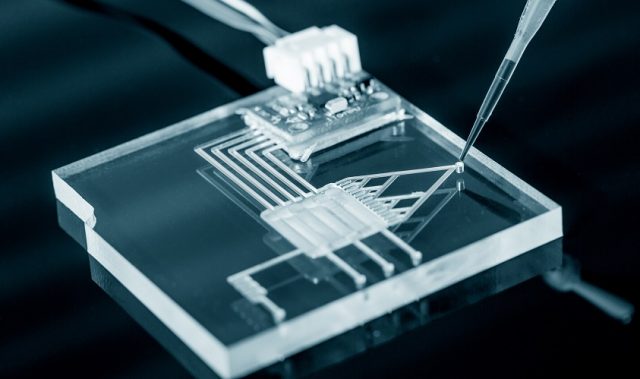
In combination with microfluidic droplet trapping approaches, enzymatically-active microgels illustrate the potential of self-assembling materials for enzyme immobilization and recycling, as well as biological flow-chemistry. These design principles can be adopted to create other bioactive amyloid-based materials with diverse functions.
The article can be found at: Zhou et al. (2015) Enzymatically Active Microgels From Self-Assembling Protein Nanofibrils For Microflow Chemistry.
———
Source: Chinese Academy of Sciences.
Disclaimer: This article does not necessarily reflect the views of AsianScientist or its staff.