AsianScientist (Jan. 16, 2015) – Scientists have developed a new method to form DNA nanostructures by using magnetic tweezers to control the formation of the structure in real time. Their research has been published in Nature Communications.
“DNA origami”, developed in 2006, is a thermal process that allows a long skeleton of DNA to be folded into an arbitrary structure by using small stapler DNA pieces. However, because every interaction among the DNA pieces occurs simultaneously, the entire processes has to be repeated multiple times in order to find the optimal conditions.
“With the existing thermal methods, we could not differentiate the reactions of the DNA because the response of each DNA pieces mutually interacted with each other,” explained Professor Yoon Tae-Young from the Department of Physics at KAIST.
In contrast, Yoon and his team have developed a mechanical way to manipulate DNA nanostructures, allowing folding to be done in just ten minutes.
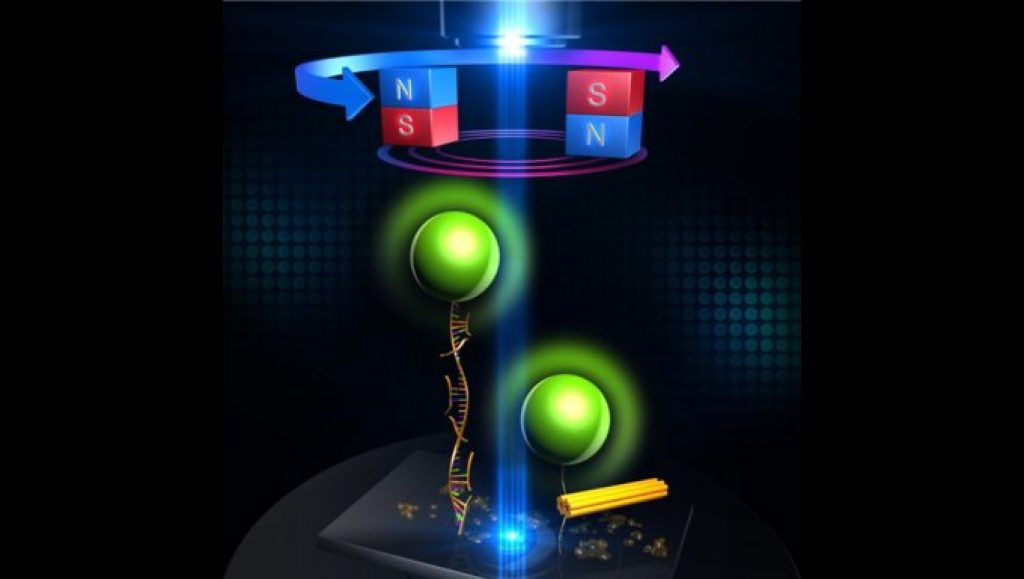
They used uni-molecular magnetic tweezers that applied force to a single DNA molecule while measuring the state of the DNA. Through this technology, they were able to induce the formation of DNA nanostructure and observe it at the same time.
During high temperature heat treatment, the first stage of conventional thermal processes, the internal structure of the long skeleton DNA untangles. To induce such state, the team attached one side of the skeleton DNA to the surface of glass and the other side to a magnetic material, unfolding the internal structure of the DNA by pulling the two sides apart with magnetic force.
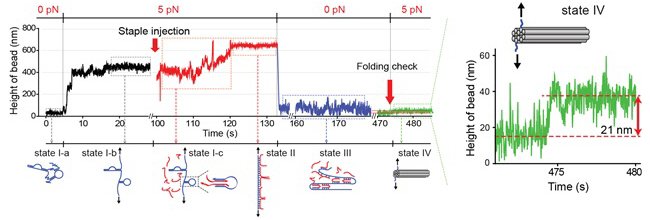
Unlike the conventional thermal processes, this method lets the stapler DNA swiftly adhere to the skeleton DNA within a minute because the sites are revealed at room temperature.
After the stapler pieces connected to the skeleton, the magnetic force is removed. Next, the structure folded through self-assembly driven by the stapler DNAs stuck to different sites on the skeleton DNA.
“Using the magnetic tweezers, we were able to sort the process of DNA nanostructure formation into a series of reactions of DNA molecules that are well known, and shorten the time taken for formation in only ten minutes,” Yoon said.
“This nanostructure formation method will enable us to create more intricate and desirable DNA nanostructures by programming the folding of DNA origami structures,” he said.
The article can be found at: Bae et al. (2015) Programmed Folding of DNA Origami Structures Through Single-Molecule Force Control.
——–
Source: KAIST.
Disclaimer: This article does not necessarily reflect the views of AsianScientist or its staff.