AsianScientist (Jan. 15, 2015) – The Okinawa Institute of Science and Technology Graduate University has launched an underwater observatory to monitor what happens in the ocean over long periods of time, even in the event of a typhoon. Called the OIST Cabled Teleoperational Observatory Platform for Undersea Surveillance, OCTOPUS has enabled a study on the behavior of plankton during a typhoon published in the Journal of Oceanography.
“We know what happens before typhoons, and after, as soon as it’s safe, you can get a boat out,” said lead researcher Dr. Mary Grossmann from the OIST Marine Biophysics Unit. “But we don’t know what happens during typhoons.”
OCTOPUS contains a dozen ocean monitoring tools, including cameras, wave monitors and temperature sensors. The station lies near the ocean floor, about 20 meters below the surface, and uses power from Churaumi Aquarium.
Grossmann used a device called the Continuous Plankton Imaging System which takes four high-resolution images every second, each focused on 30 microliters of ocean, the size of a small droplet of water. She then used the images to identify any living organism in the volume photographed. A computer helped with the work by cropping out all the empty space in each image.
“Okinawa is oligotrophic, which means there isn’t much food,” Grossmann explained. “The water is very blue and very clear, so you can see really deep, and that means there’s nothing in it.”
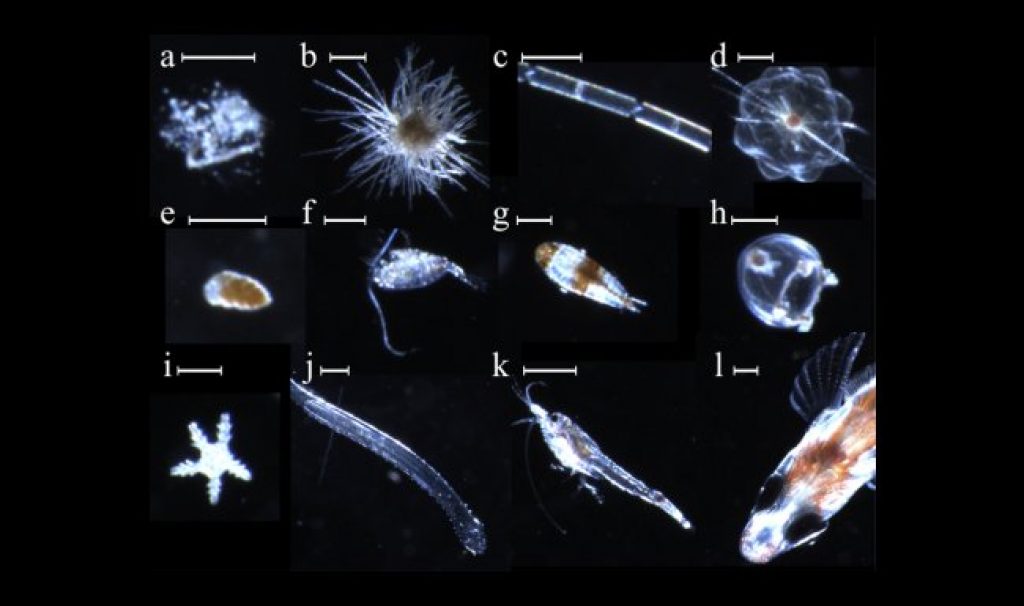
Still, Grossmann identified more than fifty thousand plankton for this study, including diatoms, radiolarians, copepods, isopods, and some small forms of shrimp, jellies, and fish.
Next, Grossmann charted how plankton levels changed over the course of the typhoon. Not every typhoon was the same, but she found a few interesting patterns. For example, diatoms and radiolarians, two groups of drifting plankton, increased during all typhoons. Some groups of plankton that are capable of swimming, including jellyfish and isopods, seem to actively avoid the high turbidity waters during a typhoon. This makes sense, since many of them are the same size as the particles of sand churning around the ocean.
“It’s like going in the forest with lots of people throwing trees at you,” Grossmann explained.
She’s not sure yet where the swimming species go during typhoons, but she thinks it may be higher in the water column, where the water stays clearer.

One of the surprising findings was the highly consistent migratory habits of several plankton species.
“Even in the middle of a huge typhoon,” Grossmann said, “they don’t change their patterns.”
Shrimp and isopods, for example, still came out to feed only at night. At one point she watched amphipods flood the images, and then a large group of chaetognaths quickly came in and replaced the amphipods. She could not account for this sudden shift until she spotted an amphipod inside one of the chaetognaths; she was watching the chaetognaths eat the amphipods.
“It’s worth sorting the plankton images manually just for a couple of photos like that,” she said.
Grossmann is quick to point out that this study is by no means comprehensive; it is more of a glimpse into the ocean that no one had seen yet. After all, she can only see a minuscule fraction of the ecosystem. She would love to mount a camera on a winch, so that it would take photographs at every depth. But there is no way that setup would survive a typhoon.
“Just with high tides and low tides it’s probably too rough to risk the camera,” Grossmann said.
In addition, she anticipates that the station will be able to collect data during more typhoons in the next season, because it is settling into the sand.
“The cables are slowly sinking,” said Grossmann, “so next year they will be more protected.”
The article can be found at: Grossmann et al. (2015) Continuous Monitoring of Near-Bottom Mesoplankton Communities in the East China Sea During a Series of Typhoons.
——-
Source: OIST.
Disclaimer: This article does not necessarily reflect the views of AsianScientist or its staff.