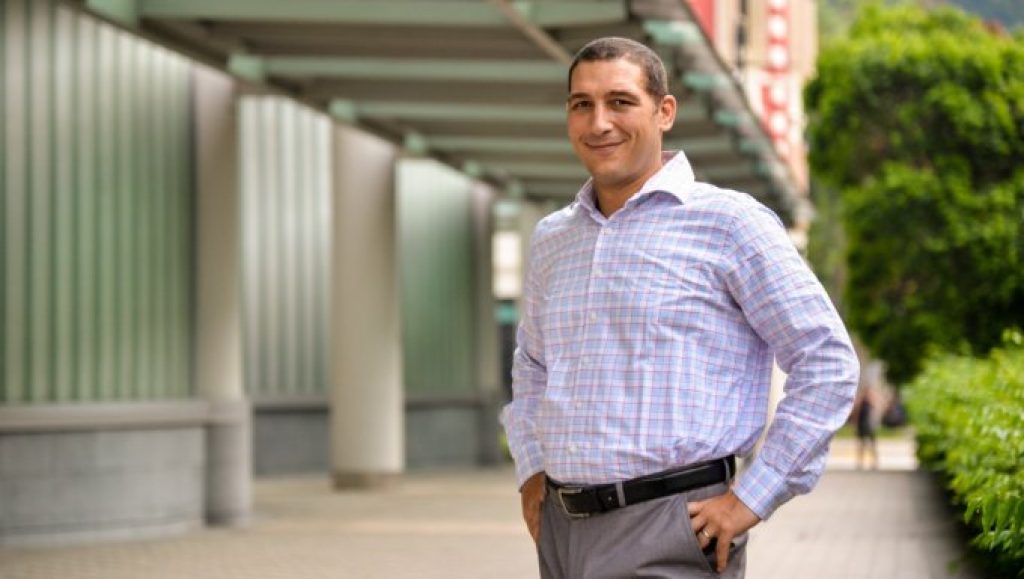
AsianScientist (Jan. 12, 2015) – By Grace Chua – From chief executive risk-taking to investor hometown advantage, chances are if there is a question on corporate finance, Assistant Professor Gennaro Bernile from the Singapore Management University (SMU) Lee Kong Chian School of Business has thought about it.
As Professor Bernile says: “Ideas are not my problem; it’s focusing on the ideas that I have.”
Indeed, a peek at Professor Bernile’s publication list reveals a broad range of collaborations with colleagues from SMU and all over the world.
He recently worked with SMU colleagues Professors Hu Jianfeng and Tang Yuehua on a study that discovered a ‘leakage’ of embargoed macroeconomic announcements, whereby the market had reacted within the time span when announcements were made to journalists and the earliest time the announcements could be reported.
“Tight control of information management and disclosure process ahead of these announcements are important,” Professor Bernile says. “The market started reacting around the time the information was given. So clearly, the word got out. It’s not hard to send a single smiley face or a frown via a text message, but it’s impossible to prove an embargo break.”
Risk-taking: from child to CEO
Professor Bernile is also collaborating with colleagues in the United States (US) and United Kingdom on a project that correlates a chief executive’s exposure to natural disasters in early childhood with the propensity to take risks in adulthood.
“It’s what we call the ‘what doesn’t kill you makes you more risk-loving’ idea,” he quips. Professor Bernile and his colleagues manually collected a dataset on natural disasters dating back to the year 1900 and cross-checked this against more than 1,600 CEOs’ birthdates and birth places. What do they plan to do with this data set now that they’ve got it? “As many things as possible,” he says.
As it turns out, the impression that an earthquake or flood leaves on a child depends on whether the child has witnessed any severe consequences of the disaster, such as death of neighbours or family members. If the child and his/her family emerge unscathed, the child would be prone to taking on more risk as a CEO, for example having the firm hold onto less cash or go on an acquisition spree. Conversely, if the child sees fatal consequences after adverse events, he or she would display less risk-taking behaviours later in life.
Do gender differences play a part too? Perhaps, says Professor Bernile, but the sample size of female chief executives is too small to tell.
These may seem like a diverse range of projects, but there is method to the madness. Much of Professor Bernile’s research focuses on factors that induce firms to take risks, whether it is the CEO’s childhood experiences or a lack of diversity in the management board.
His work has real-world relevance, too. The management boards of companies could one day look at data about a CEO’s childhood experiences and say: perhaps so-and-so is a good choice if we want the company to go out on a limb and grow fast, whereas so-and-so might be a better choice if we want the firm to play it safer and grow steadily but slowly.
Inspiration and proximity
Professor Bernile says his myriad of ideas comes from a combination of factors. “Reading the news and my interactions with colleagues and guest faculty are two very important sources of inspiration. Also, I do like to think about how things I learn outside of—and that are seemingly unrelated to—finance may apply to our domain,” he adds.
So what’s next? Together with colleagues from the US, Professor Bernile is now examining whether and how geographical proximity to a firm’s headquarters provides an advantage to investors living nearby.
Conventional wisdom seems to suggest that investors who are located near a firm’s headquarters tend to have a head start. But Professor Bernile and his colleagues found that this advantage had disappeared since Year 2002, when new regulations that forced firms to disclose information in a widespread, equitable way came into effect.
They found instead that advantages did exist if an investor were to live near the business-related activities of a company (such as branches, customers or suppliers). This proximity allowed the investor to track the activity of trucks moving in and out of a factory or the number of patrons at a retail outlet, for instance.
Innovation from interaction
Professor Bernile is also looking to use publicly available commercial patent databases to study the impact of interactions between innovative firms.
“If firms interact, we might expect their valuations to be correlated. Such correlation affects investors’ ability to diversify, exploit information about one firm to trade on another firm, and affects the firms’ incentives,” he explains. ‘Interaction’ refers to cooperation, such as collaborating on patents or citing each other’s work, as well as competition that is measured via the rate of patent litigation.
Professor Bernile’s research on interaction is particularly relevant to a highly networked Singapore. “There is a big push here to make Singapore an innovation hub, implicitly creating these interactions among firms. But the Monetary Authority of Singapore also has an incentive to maintain the financial stability of the system. It’s not clear if these two objectives are attainable at the same time.”
Policy makers in Singapore, then, might be interested to find out what the potential risks of such an approach are, and how to hedge those risks—perhaps by promoting collaboration throughout the region instead of concentrating it only in the Singapore market.
Either way, there is no stopping Professor Bernile from coming up with new innovative research ideas.
Asian Scientist Magazine is a media partner of the Singapore Management University Office of Research.
——
Copyright: SMU Office of Research. Read the original article here; Photo: Cyril Ng.
Disclaimer: This article does not necessarily reflect the views of AsianScientist or its staff.