AsianScientist (Oct. 17, 2014) – “Does eating french fries help you poo?” my six year-old asked me over a fish and chip lunch recently.
Every parent of a young child has likely been faced with a similar type of question about the workings of the human body. It usually happens at an inopportune time (like in a crowded elevator) or when you’re in the middle of a different train of thought and are stumped for an answer.
His question, and many more, were answered at the incredibly immersive Human Body Experience exhibition at the Science Center Singapore. Covering the five main systems of the body—the circulatory, digestive, immune, nervous and respiratory systems—the experience was a sensory, tactile, and visual blast. Think Baz Luhrmann’s Moulin Rouge meets Bill Nye the Science Guy.
Larger-than-life exhibition
I brought my son Jordan and his eight year-old cousin Tyan to the exhibition. Jordan was slightly apprehensive as he’d always been a bit squeamish, though curious, about bodily processes. But he was reassured by the presence of his gung ho older cousin.
When we arrived, the first thing we saw was an enormous six-meter tall bespectacled human face with a gaping mouth. “Wow!” exclaimed one kid, “Whoa…” said the other. “The entrance is up the giant red tongue,” said a smiling employee.
While Tyan scrambled ahead, quickly disappearing down the throat, Jordan and I climbed in carefully, coming face-to-face with an esophagus slide! We slid down, laughing, and found ourselves in the larynx, replete with vocal cords that made different tones when touched. While the kids tugged and pulled at the various cords to sound different pitches, I cleared my throat and hummed, marveling at the biological process within me that were amplified all around.
Expanding lungs, pulsating hearts and bouncy cells
We rounded a corner and came face to face with a glowing, gently expanding lung, surrounded by a ribcage. We all stared, entranced for a moment, our breathing slowing to the calming rhythms of the respiratory organ. A good thing, as the next section proved to be one huge sensory experience.

“The lights are making me a bit dizzy!” yelled Jordan over the heavy beats of the heart. “This is so cool!” said Tyan at the same time. Both were happy to stay a little longer until the flashing lights made us all a little disoriented.
We eventually made our way out of the heart and on to the immune system, an eerily lit landscape with blue-grey bacteria dotting the walls. The kids respectfully kept their hands to themselves, not wanting to catch an infection. “It’s good that we sanitized our hands before we arrived,” said Jordan.
Get ready to have your mind blown!
From fighting diseases, our virtual hologram guide, the aptly named Professor X ushered us into the “the boss of the body”: the brain. We pushed and squeezed our way through a massive maze of neurons, the cells that process and transmit information in our minds through electrical and chemical signals.
At last we emerged into a room straight out of a science-fiction movie. Surrounding us were mirrors that reflected the infinite possibilities of the brain. Slicing straight through the room was a suspended walkway with shifting patterns beamed on it.
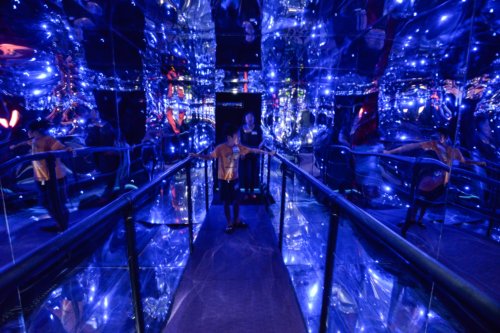
What does it feel like to be swallowed?
We moved from the cerebral to the downright visceral. The churning stomach awaited us and it was everything you imagined it to be and more. Squeezing through the soft passage of the esophagus, we wobbled through the soft lining of the human stomach. This was when the full sensory experience hit us, and the three of us immediately grabbed our noses and went “what on earth is that smell?” As Tyan put it, the pong hit us like a “wet market and toilet rolled into one”.
We later learnt that the smell was deliberate. We certainly felt like particles of food being digested after that!
Perhaps the squelchiest part of the whole experience was the process of being digested through the intestines. Walking over the undulating soft floor of the small and large intestines, we bumped into each other as we tried to maintain our footing. Jordan later reflected that french fries probably weren’t the best things for the stomach to digest. “They’re a bit too hard. Perhaps something softer like prunes or ice cream?” he asked hopefully.
Pooped out, quite literally

After being digested, we pushed our way out of the intestines and emerged into daylight! Now I understand where the term “pooped out” comes from. We were exhilarated, but quite spent from our experience. The kids emerged with a deeper understanding and appreciation of the multitude of processes happening within our body every day.
When I asked Tyan what he would tell his friends about The Human Body Experience, he replied, “You should definitely go because some parts are like a playground! But I won’t tell you which parts. You just have to see for yourself!”
The Human Body Experience is a walk through attraction that features large-scale sculptures of the human anatomy. Admission rates (which includes Science Center admission): $20 for adults; $15 for children (3-12 years).
Asian Scientist Magazine is a media partner of Science Center Singapore. For more photos of Dora and the kids at HBX, please click here to see the Facebook photo album.
——
Copyright: Asian Scientist Magazine.
Disclaimer: This article does not necessarily reflect the views of AsianScientist or its staff.